

Swing Trading · Lesson 14 of 15 · Reviewed November 10, 2026
A routine turns a collection of trading ideas into an operating process. It specifies when information is checked, which decisions are allowed, and how exceptions are handled. For swing trading, the routine must work across several sessions and through periods when the trader cannot watch prices. A schedule that exists only on paper is not a reliable control.
Start with actual availability rather than an idealized trading lifestyle. Identify the times when the account can be reviewed carefully and the situations in which that review becomes impossible. A routine should be capable of declining a new position when work, travel, illness, or unclear information prevents the required checks. Its usefulness includes the ability to stop.
1. Separate research time from instruction time
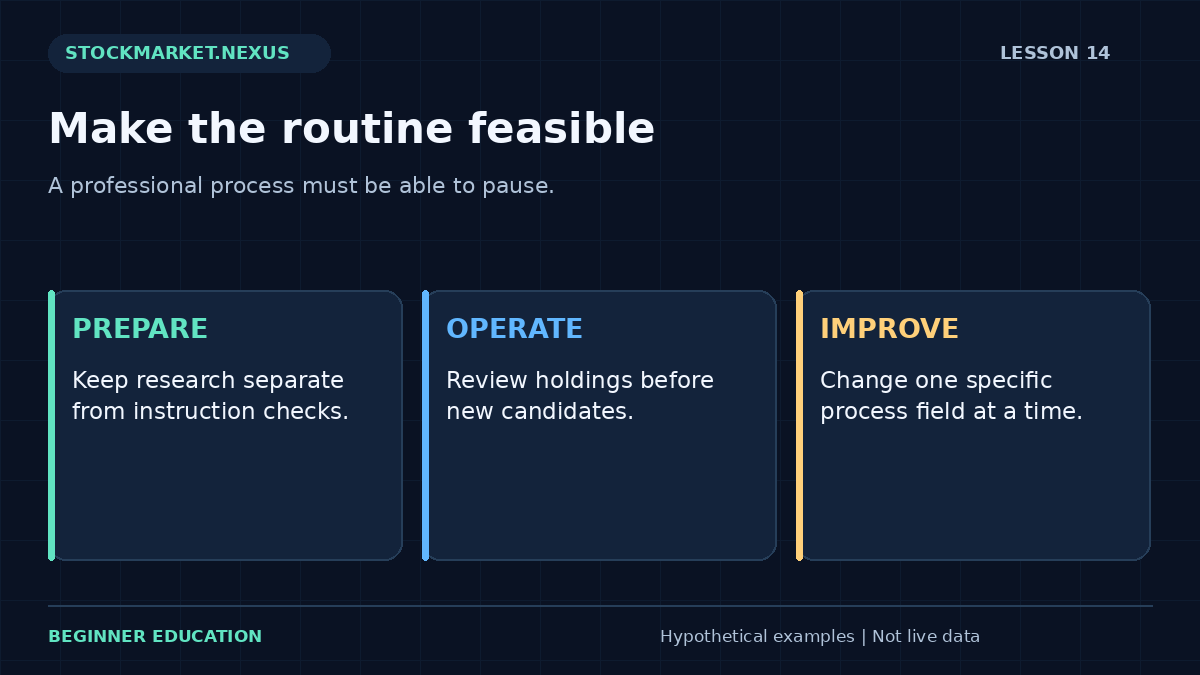
Research can include updating an observation list, annotating completed charts, and checking upcoming events. Instruction time requires current quotes, account capacity, and a final eligibility check. A candidate studied yesterday can change before today's order. Keeping the stages distinct prevents research effort from becoming automatic permission to trade.
Use a short readiness card before any instruction: security identity verified, data current, event window checked, quantity calculated, available funds confirmed, and exit procedure understood. Each field should have a concrete answer. A general statement that the setup looks good does not substitute for the missing fields.
The watchlist guide organizes research candidates without turning them into a buy list. The routine then decides which candidates deserve a current decision card and which should remain under observation or be removed.
2. Use completed information at the scheduled review
If the method relies on completed daily bars, schedule the review after the relevant session is complete and the data are available. Specify the time zone and source. A chart viewed before completion can change, so its provisional state should not be described as a confirmed closing condition.
Record the actual review time. If a later-than-usual review changes the next available entry opportunity, retain that fact rather than assuming the earlier ideal price. Operational delays are part of the method's real feasibility. They should not be removed from the study solely because they make the results less attractive.
The chart structure lesson explains the distinction between context, confirmation, and execution. The routine should preserve those stages even when all three appear close together on a historical chart.

3. Review existing positions before adding candidates
Start with actual holdings, not with the most exciting new setup. Check quantity, fills, open orders, event timing, and whether each original hypothesis remains valid. A partially filled exit or an unconfirmed cancellation can require attention before the account takes on another position.
Recompute account-level planned exposure and purchase commitments under a consistent convention. Several positions can share the same economic driver even when their tickers differ. The routine should identify that concentration rather than relying solely on the number of holdings.
The portfolio heat guide provides a simple account ledger. Its role is to keep the full account visible. A new candidate can be individually eligible yet fail the account-level review because it duplicates exposure or exceeds a planning boundary.
4. Create a specific overnight checkpoint
Before carrying or adding exposure, identify what can occur before the next planned review. Check scheduled company events, relevant market closures, and personal availability. Record uncertain timing as uncertain. The absence of a known event does not imply that no surprise can occur.
Verify the active instruction rather than relying on a chart line. Check its quantity, price, duration, and supported sessions. An alert that requires a human response is not equivalent to an active order. The routine should name which tasks remain dependent on the trader being available.
The overnight and weekend lesson explains the adverse opening scenario. The checkpoint is complete when the trader can state both the intended response and the limitations of the available instructions.
5. Define exceptions before they become urgent
List the conditions that require pausing new activity: unclear balances, stale data, an unfamiliar corporate action, an order-status discrepancy, or inability to complete the next review. The procedure should specify what must be verified before resuming. A vague rule to be careful is difficult to apply when the market is moving quickly.
Do not submit duplicate instructions merely because confirmation is delayed. First establish the actual order status through the broker's supported process. A second order can create unintended exposure if the first later fills. Operational uncertainty is a reason to investigate, not to replace evidence with repeated clicking.
Also define the response to a missed review. The next action should begin with account reconciliation and current eligibility, not with an assumed continuation of yesterday's plan. A routine that treats every missed checkpoint as harmless can accumulate unexamined exposure across several sessions.
6. Keep the weekly review separate from daily management
The daily review operates the current rules. A broader periodic review evaluates whether those rules and the routine remain useful. Mixing them can lead to changing the method after every outcome. Preserve the distinction between following today's plan and deciding whether a future version should be different.
Choose one concrete improvement question at a time. For example: were event dates verified consistently, did actual entries exceed the permitted boundary, or were partial fills reconciled promptly? These questions produce observable changes. A promise to become more disciplined does not specify what the next session should do differently.
Retain both compliant losses and noncompliant gains. The process review should not reward every profitable exception or punish every rule-following loss. Outcome and behavior are related evidence, but neither can replace the other. A complete routine records them in separate fields.
Define what each checkpoint produces
A checkpoint should end with an observable output. The research check produces a dated observation list. The account check produces confirmed holdings, available funding, and order statuses. The decision check produces an approved, rejected, or unresolved card under the method. A checkpoint that merely says review charts is harder to evaluate because completion has no clear evidence.
Keep the outputs short enough to maintain. A few consistent fields can support a reliable routine, while an elaborate daily report may become a burden that encourages shortcuts. The objective is a record another person can follow, not paperwork for its own sake. Remove fields that do not support a decision, but preserve those needed to reconstruct eligibility and execution.
At the end of a practice week, inspect whether the outputs were actually produced on schedule. Missing records are evidence about feasibility. Do not fill them retrospectively as though they existed at the time. A later reconstruction can be labeled as such, while the absence of the original checkpoint remains visible for process review.
Create a decision queue instead of reacting to every alert
Alerts can help direct attention, but several can arrive together or refer to conditions that no longer fit the plan. A queue allows the operator to verify identity, current quote, event window, and account capacity before acting. The alert is an invitation to inspect a condition, not automatic authorization for an instruction.
Record the alert's source and timestamp when it materially affects a decision. A delayed notification may refer to a price no longer available. If the actual quote is outside the maximum entry, the method can produce no trade even though the alert was valid when generated. Preserving that distinction prevents a notification history from becoming an assumed execution record.
Set a limit on the number of candidates that can be reviewed carefully within the available window. The limit is an operational choice, not a universal optimum. If the queue repeatedly exceeds capacity, narrow the research process or revise the schedule. Rushing every candidate through incomplete checks is not a meaningful solution to an overloaded routine.
Separate a market exception from a technology exception
A gap or announcement changes the market environment. A stale feed, unavailable app, or unclear order status changes the operator's information and control environment. Both can require pausing activity, but they need different verification steps. A chart adjustment cannot resolve an account-status discrepancy, and a refreshed browser cannot remove an adverse market move.
Write the information required before resuming in each case. For stale data, verify a current source and timestamp. For an unclear instruction, establish the broker's actual status. For a changed event, revisit the eligibility rule. The procedure should direct the next check rather than encouraging repeated action without evidence.
Practice a combined exception in which an announcement occurs while the app is unavailable. The correct record may contain unresolved exposure and a delayed verification sequence. Do not invent an immediate fill to make the exercise feel complete. A professional routine acknowledges what could not be known or controlled during the interval.
Use a weekly review to change one rule at a time
A periodic review can identify recurring operating errors, but changing several rules simultaneously makes it harder to understand the effect of each. Choose one specific adjustment, label the new version, and preserve the earlier record. The next fixed practice block can then assess whether the targeted behavior becomes more consistent.
For example, replace a vague event check with a required issuer-source timing field before every new position. The improvement question is whether the field is completed accurately and whether it changes eligibility decisions. It is not whether the next few trades happen to make money. A process correction and a return outcome operate on different evidence.
If the change makes the routine too time-consuming, record that limitation. A theoretically thorough process that cannot be maintained may need simplification or a smaller candidate universe. Feasibility is part of professional design. The goal is a routine that can actually be operated under the person's schedule, including ordinary interruptions.
Rehearse an entire holding cycle
Choose one fictional candidate and follow it from observation through expiration or final exit. Produce each checkpoint at its scheduled time. If no entry qualifies, complete the research card with no trade. If an entry fills, maintain the position and instruction ledger through every revealed session, including uneventful ones.
Introduce one adverse opening, one changed event date, and one partial fill. These events test different parts of the routine. The exercise is successful when the operator can reconstruct the actual holding and the next permitted action at each stage, not when the fictional price path ends profitably.
Finally, list which parts required judgment and which were simple verification. This can guide improvements without automating decisions that still need a clear mandate. A repeatable routine does not remove uncertainty. It organizes the checks and records that make uncertainty manageable enough to inspect honestly.
## Worked exercise: a realistic evening schedule
Design a fictional 25-minute review with five minutes for account reconciliation, five for event checks, ten for a small watchlist, and five for writing decisions. This allocation is an operating example, not a universal required schedule. Test whether the actual number of holdings and candidates can be reviewed carefully within it.
Now introduce an exception: an exit requested earlier has no clear confirmation. The account review takes the full 25 minutes. Under a routine that prioritizes reconciliation, no new candidate receives automatic approval. Record the unfinished research and the reason for pausing rather than compressing the remaining checks into a rushed final minute.
Finally, simulate an upcoming trip that prevents the next two reviews. Write which new positions become ineligible under the routine and how existing exposure will be addressed under its established rules. This exercise reveals whether the method fits the person's actual life instead of assuming unlimited attention whenever a chart becomes interesting.
## Frequently asked questions
What should happen after a missed review? Begin with current account reconciliation and eligibility. Do not assume yesterday’s plan remained valid through the missed interval. Record the gap in the process honestly and identify what must be verified before new activity resumes. A later reconstruction can help learning, but it should not be labeled as an original timely decision.
How many candidates should a routine include? Use a number that can be reviewed carefully within actual availability. There is no universal count that guarantees quality. Track unfinished checks and recurring overload. If the queue repeatedly exceeds capacity, narrow the universe or revise the schedule rather than treating rushed verification as completion.
## Sources and further reading
Online account and order checks provides background for the concepts discussed. All numerical cases and worksheets in this lesson are original fictional illustrations, not historical performance results.