


Swing Trading · Lesson 10 of 15 · Reviewed November 10, 2026
A swing position remains exposed between sessions. New information can change the prices buyers and sellers are willing to accept before the next regular opening. The next available quote can be far from the previous close, and the market does not have to trade at every intervening price. That discontinuity is the core of gap risk.
The practical response is not to assume every night will produce a crisis. It is to acknowledge that a chart line, an alert, and an active order provide different functions. Each has limits. A complete plan identifies which actions are automated, which require attention, and which adverse outcomes remain possible despite those arrangements.
1. Distinguish closing value from an available exit
A position marked at the previous close has an accounting reference, not a promise about the next sale. A last trade may also differ from the current bid. When evaluating an adverse scenario, use an explicitly defined available exit price rather than treating the prior close as liquid cash.
For example, 20 fictional shares bought at $50 and marked at a $51 close have a $20 unrealized price gain relative to entry. If the next available bid is $45, selling produces a $100 price loss before charges. The prior evening's mark did not lock in the gain. Realization requires an actual execution.
The position-sizing lesson connects this difference to quantity. Smaller exposure changes the dollar consequences of a gap, but it does not make the opening path predictable. Keep the price scenario and the share count as separate inputs.
2. Understand the stop-order tradeoff
A stop order activates according to the broker's specified trigger rules and becomes a market order when triggered. Its execution price can differ from the stop price. A sell stop at $48 does not guarantee a $48 sale if the next available prices are lower. Confirm the sessions and standards under which the instruction can activate.
A stop-limit instruction combines a trigger with a price boundary. If the market moves below the sell limit without offering an eligible fill, the position may remain open. That can avoid an execution below the specified limit while preserving exposure to further decline. The instruction changes the tradeoff rather than removing uncertainty.
The swing exit and order guide explains how to connect these instructions with the thesis. Do not choose an order name solely because it sounds protective. Explain what it does under the adverse opening scenario that matters to the plan.
3. Verify extended-hours availability instead of assuming it
Extended-hours services, accepted order types, eligible securities, and execution conditions vary by broker. A position visible on an app is not necessarily covered by every order instruction in every session. Check the actual agreement and order status. The relevant question is whether the intended action is supported when the plan expects it to operate.
Outside regular hours, the market environment can differ in liquidity, spreads, and available participation. A displayed price does not establish that the entire intended quantity can be executed there. A small after-hours transaction is not proof that a larger position can be closed at the same price.
If the routine does not include extended-hours trading, say so explicitly. The plan then carries exposure until the next permitted execution opportunity. That is a meaningful operating constraint. It should not be hidden behind an assumption that an overnight alert creates an immediate and reliable exit.
4. Treat weekends as a longer information interval
A weekend holding can span more calendar time without regular-session trading. Announcements, geopolitical developments, and company-specific changes can occur during that interval. The longer closure does not establish a precise probability of a gap, but it changes how long the position remains exposed before the next planned review or execution window.
Use a scheduled pre-weekend review. Check the current holding, open instructions, known events, and personal availability. A blanket rule to always hold or always close is a method choice that requires evaluation; it is not a universal answer. The important point is that the choice is made before the weekend outcome is known.
The swing-trading routine lesson turns this into a concrete checklist. The review can end with retaining, reducing, closing, or declining new exposure under the method's rules. Each decision should have a record rather than being inferred from the later chart.
5. Use scenario analysis without inventing odds
Construct several fictional next-opening bids and calculate their effects. At a $50 entry for 20 shares, bids of $48, $45, and $40 imply price losses of $40, $100, and $200. Add applicable explicit charges separately. These are conditional results, not forecasts or probability estimates.
Do not call the lowest scenario the maximum possible loss merely because it is the lowest row in the worksheet. A long stock can suffer a much larger decline, and some interruptions can prevent immediate execution. State what the model covers and what remains unresolved. A scenario table is useful because it makes assumptions inspectable.
Also consider account-level effects. Several holdings can gap together after a shared event. A collection of individually tolerable scenarios may become unacceptable in aggregate. The portfolio heat guide explains why the overnight review must include the full account.
6. Rehearse the decision before revealing the opening
Use the Swing Trading Practice Lab to reveal fictional sessions sequentially. Enter a position only after recording its quantity, protective trigger, and target. Before advancing, calculate what a lower opening bid would mean. The next revealed session can then test the plan without allowing the decision to borrow future information.
The simulator simplifies execution and cannot reproduce all real-market conditions. Its purpose is to show the consequence of a trigger being crossed at an available price different from the intended level. An educational replay should make its assumptions visible rather than encouraging the visitor to mistake a smooth interface for realistic market completeness.
After an adverse reveal, classify the result honestly. A gap loss can occur under a compliant plan. A decision to increase the position after the loss is a separate action that needs its own authorization under the method. Do not use the unpleasant outcome as an automatic reason to abandon the original rules.
Distinguish overnight loss from the total trade result
A gap measured from the previous close is not necessarily the same as the position's result from entry. Suppose shares were bought at $40, closed at $44, and next opened at a $41 bid. The overnight price change is minus $3 per share, while selling at $41 produces a plus $1 price result relative to entry. Both figures can be correct under their definitions.
Now suppose entry was $43 instead. The same $44-to-$41 opening gap produces a $2 loss from entry. A journal should record the relevant references rather than using the word loss ambiguously. Overnight change helps describe the session discontinuity; total trade result measures the full holding's economic outcome.
This distinction matters when reviewing protective adjustments. A position can give back unrealized gains without becoming a losing trade, but that does not automatically mean the exit process was followed. Conversely, a profitable final sale can still occur after an unauthorized change. Preserve both the price path and the rule record so neither accounting reference becomes a substitute for process review.
Plan for unavailable execution, not only unfavorable execution
A gap worksheet often assumes that a bid is immediately available and the whole position can sell. Some situations involve interrupted trading, insufficient available interest, or an instruction that is not eligible in the relevant session. In those cases, the account may remain exposed while the intended action cannot complete under the assumed conditions.
Label that branch as unresolved exposure rather than assigning a convenient execution price. Record the current mark separately from any realized result. If a later quote becomes available, update the position through the actual or explicitly modeled instruction sequence. A no-fill should not be treated as a zero-loss exit.
The operational plan should identify how account and order status will be verified during an interruption. It should not promise that repeated submissions will force a fill. Duplicate instructions can create a new problem when trading resumes. The first task is to understand the existing holding and active orders through the broker's supported process.
Evaluate the attention cost of simultaneous gaps
Imagine three positions all requiring review at the same opening. One has a triggered exit, one has a partially filled sale, and one has an event-related quote discrepancy. Even if the dollar exposure is within the practice boundary, the operator may not be able to resolve all three issues carefully at once.
Include that workload in the portfolio review. A method that is feasible for one holding may become difficult when several positions share event timing. The number of names is less important than the number of independent exception procedures likely to demand attention together. A simple exposure map can reveal those clusters before the next session.
Practice the sequence on paper: identify the actual quantity, verify active instructions, resolve the most urgent uncertainty under the established procedure, and document each action. The goal is not to prescribe a universal priority rule for every account. It is to determine whether the chosen routine has an intelligible response rather than relying on improvisation during a stressful opening.
Review weekend policy with complete evidence
A rule that reduces exposure before weekends should be evaluated using the actual or consistently modeled closing and reopening instructions. It can avoid some adverse gaps while also missing favorable moves and incurring additional friction. A fair comparison includes both sides. Selecting only memorable bad weekends creates an incomplete case for the rule.
Use the same universe, dates, and cost convention for the hold and reduce alternatives. Record events and unavailable execution opportunities consistently. If the method changes quantity rather than closing everything, calculate the remaining exposure and the transaction costs of the reduction. The policy is more specific than a simple label such as weekend safe.
After a fixed practice block, report what the evidence supports and what it does not. A small set of fictional or historical examples can teach mechanics and reveal operational demands. It cannot certify that a weekend policy will protect future capital. Keep the conclusion proportional to the data while preserving the practical value of having made the decision before the outcome.
## Worked exercise: stop versus stop-limit
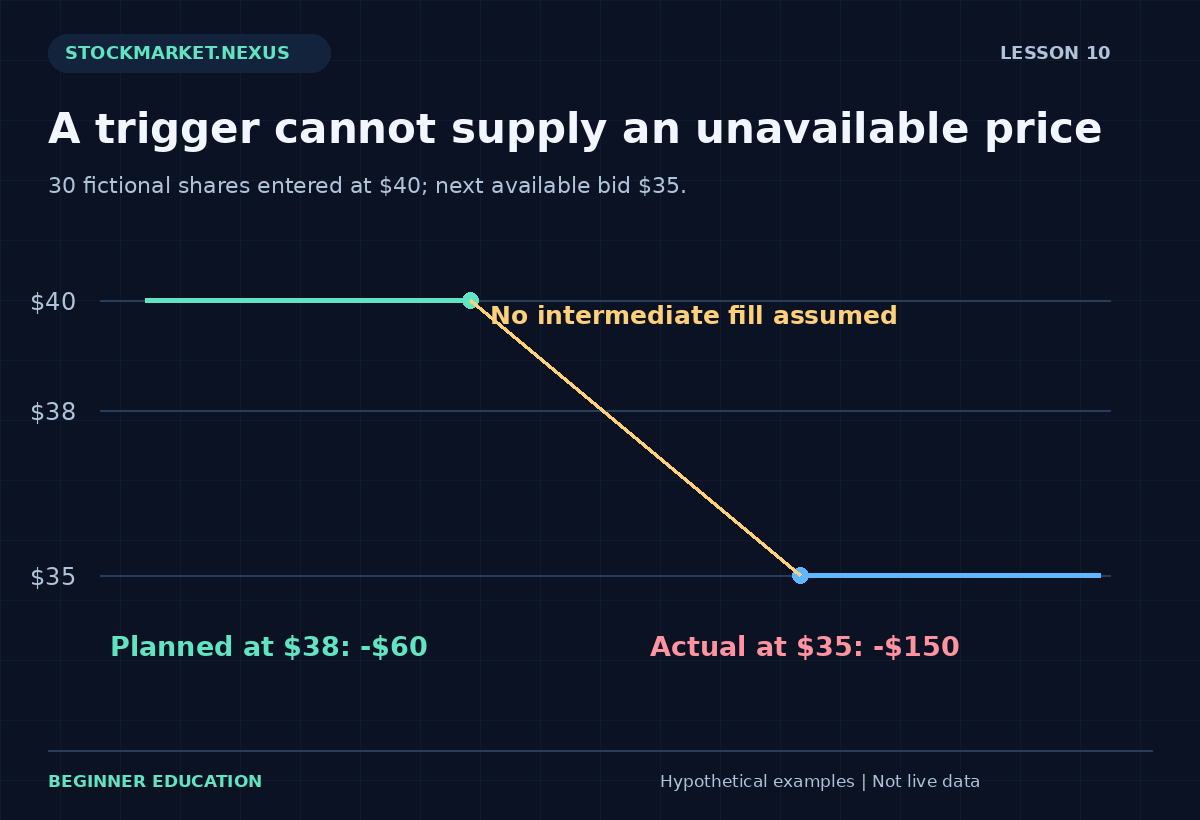
Assume 30 fictional shares entered at $40. A sell stop is set at $38. A separate alternative uses a $38 stop trigger and a $37.50 sell limit. The next available bid is $35. In a simplified full-fill model, the stop-market alternative can sell at $35, creating a $150 price loss before charges.
The stop-limit alternative cannot assume a $37.50 sale when no eligible price is available. Record the position as still open under that scenario rather than marking a smaller realized loss. Its current value and further exposure still matter. A no-fill is an operational outcome, not a favorable execution.
Now reveal another bid of $33. Explain how the two account states differ: the first alternative already has a realized result, while the second still holds shares unless another instruction executes. The exercise shows why controlling the minimum acceptable sale price and ensuring a sale are distinct objectives with different consequences.
## Additional calculation check
When comparing the gap scenario with the plan, use the same cost convention on both sides. If a $1 entry charge and $1 exit charge apply, add $2 to the completed round trip rather than adding a separate assumed spread already reflected in the bid and ask. Label any additional slippage model explicitly. A clear convention prevents the apparent difference between planned and actual results from being partly caused by inconsistent accounting rather than the adverse opening itself.
Frequently asked questions
Can an alert prevent an overnight gap loss? An alert communicates information according to its own source and delivery behavior. It does not guarantee that the trader can respond or that an eligible execution is available. Record which actions still require attention and verify the actual broker instruction. The presence of a notification should not be treated as equivalent to a completed protective sale.
Is the previous close an available sale price? It is a historical reference. The next executable bid can differ, and the intended quantity may face different available interest. Use actual fills for the ledger and explicitly modeled prices for scenarios. Keeping the closing mark separate prevents unrealized gains from being mistaken for cash already secured in the account.
## Sources and further reading
Extended-hours trading considerations provides background for the concepts discussed. All numerical cases and worksheets in this lesson are original fictional illustrations, not historical performance results.