

Swing Trading · Lesson 02 of 15 · Reviewed November 10, 2026
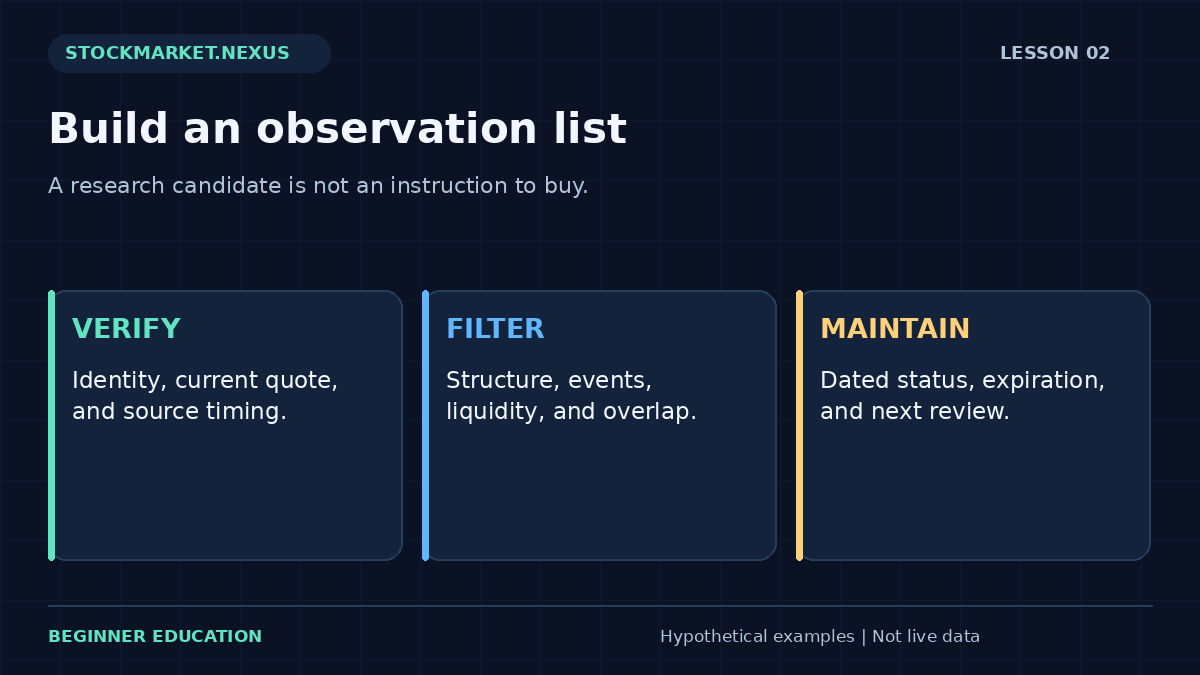
A useful swing-trading watchlist is a small collection of research questions. It identifies securities worth observing under a defined routine, not securities that must be bought. The distinction is practical: a good candidate can remain untraded because its entry never becomes available, its event calendar changes, or another holding already creates similar exposure. The list should support those decisions without making inactivity feel like failure.
Begin with the intended holding horizon and review schedule. A strategy evaluated on completed daily bars needs current daily data and a way to check announcements between reviews. A list assembled from fast intraday movers may not serve that purpose. The larger the mismatch between the screening process and the actual trading routine, the more work is required to repair each candidate afterward.
1. Define the universe before looking for patterns
Specify which instruments are eligible for research. For a beginner's fully paid stock exercise, an eligible universe might exclude leveraged products, unfamiliar foreign listings, and instruments whose terms have not been understood. This is an educational boundary, not a claim that every excluded security is unsuitable for every investor. Its purpose is to keep the exercise internally consistent.
Record each security's exact identity. Company names, share classes, tickers, listing venues, and fund structures can differ. A stock and an exchange-traded product with similar price behavior do not necessarily create the same exposure. Review the security itself before applying a chart template. Instrument identification is a prerequisite, not an administrative step to finish after a signal appears.
Also define how a candidate enters and leaves the universe. A database limited to today's surviving companies cannot automatically represent a historical universe. If the list will later support a study, retain dated membership. Otherwise, removed or failed securities can disappear from the evidence, making the remaining charts look more favorable than the original opportunity set.
2. Use liquidity as a practical filter
Volume describes completed activity over an interval. Liquidity concerns the ability to execute the intended quantity at available prices. A high average volume does not guarantee a narrow spread at the moment an order is submitted. An earnings announcement or a thin opening can produce conditions unlike the previous day's summary statistics.
For each candidate, record the current bid, ask, timestamp, and an example quantity. A four-cent spread costs a different dollar amount for 20 shares than for 2,000 shares. The screen should connect market conditions to the proposed trade size. Avoid using a single attractive volume number as a universal execution-quality certificate.
The volume, liquidity, and spread guide explains those distinctions in detail. For a swing-trade list, add a second check: whether the position could need attention during an opening gap or outside the usual review window. Ordinary daytime liquidity is only one part of the operating problem.
3. Describe the structure in plain language
Replace labels such as strong chart with observations that can be checked. A fictional candidate may have a completed consolidation bounded by $28 and $30, with no permitted entry above $30.40. Another may be pulling back within a rising daily sequence but has not yet produced the planned trigger. These descriptions separate location from action.
Include the timeframe and the date of the observation. A weekly trend can remain upward while the daily chart deteriorates. A daily pattern can be incomplete even when an intraday move looks convincing. Write the structure that the method actually uses rather than choosing the most flattering timeframe after reviewing several charts.
The daily and weekly chart lesson offers a way to keep those views separate. The watchlist only needs a concise summary and a link to the annotated chart. It does not need an elaborate narrative designed to persuade the reader that a trade should happen.
4. Check the event calendar before ranking candidates
Identify scheduled company events within the possible holding window. Verify earnings timing from the issuer's investor-relations materials where possible, and distinguish a confirmed announcement from an estimated calendar date. A date described as expected should remain labeled as expected. The uncertainty itself may be relevant to the plan.
Broader events can matter as well, but avoid creating an unmanageable catalog of every possible announcement. Record events that the method explicitly treats as decision points. The goal is a repeatable screen, not a retrospective explanation for every price move. An unforeseen event can still occur even after a careful calendar check.
Use the site's earnings calendar as a starting point, then verify important details with the issuer. The final record should say what was checked, when it was checked, and whether the candidate's holding window would cross the event. Those fields make later review possible without implying that a calendar can eliminate surprise.
5. Rank clarity rather than excitement
A simple watchlist score can assess completeness: identity verified, chart condition defined, acceptable entry boundary written, event window checked, and liquidity reviewed. This is a process score. It is not a forecast probability or an expected-return ranking. Calling it a probability would require evidence the checklist does not provide.
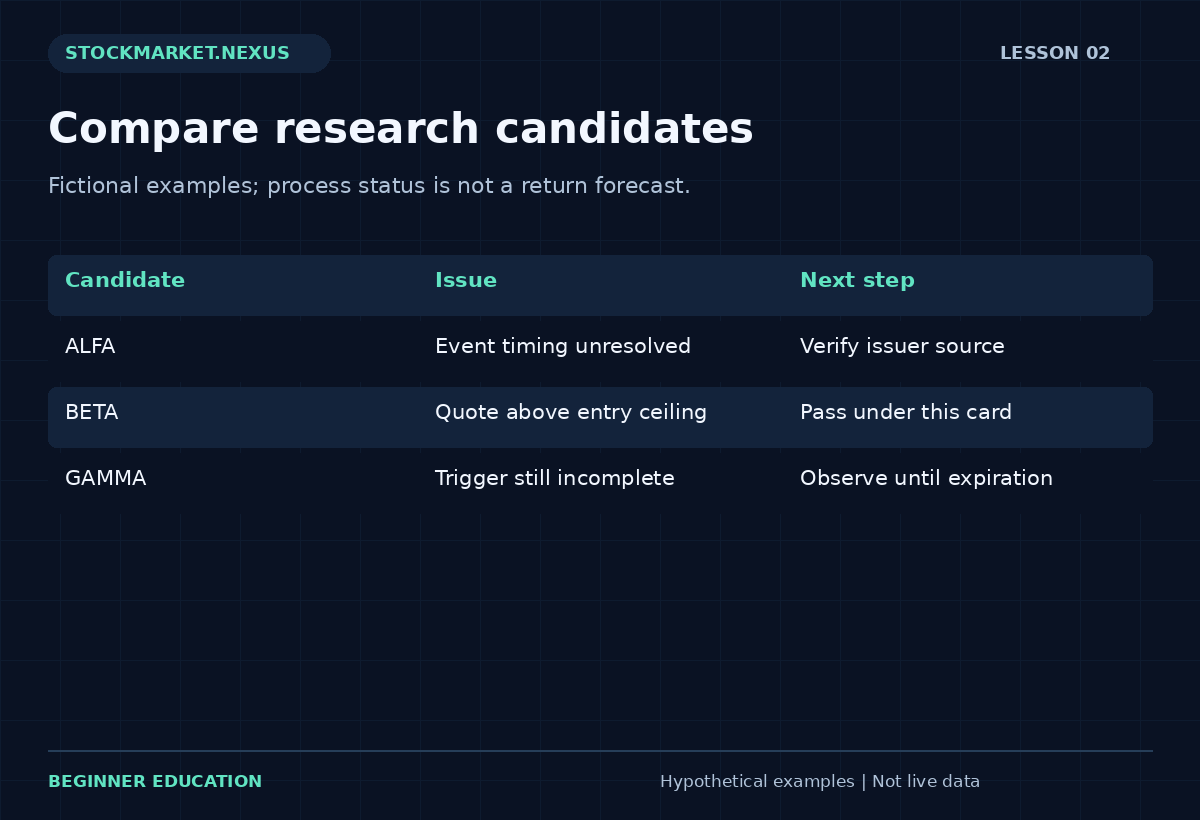
Consider three fictional candidates. ALFA has a clear consolidation but an earnings release tomorrow. BETA has no near-term scheduled event but a spread too wide for the exercise. GAMMA has readable structure, current information, and no prohibited event in the stated window. GAMMA may deserve observation first, but that ranking still does not authorize an entry.
Keep a reason-to-pass column beside the reason-to-watch column. This reduces the temptation to treat accumulated research as a commitment. If a candidate has been followed for a week, the time spent studying it does not improve its next execution price. Research effort is a sunk cost, not an entitlement to a favorable trade.
6. Maintain the list with dated decisions
At the scheduled update, classify each candidate as observe, eligible, expired, or removed. Use definitions that prevent overlap. Observe means a condition is incomplete; eligible means all stated requirements currently hold; expired means the observation window has ended; removed means a disqualifying condition appeared. None of these labels means a guaranteed outcome.
Store the previous status rather than overwriting it without history. A candidate may move from observe to eligible and then to removed before any execution. That sequence is useful evidence about the method's operational demands. A final screenshot alone would hide the decisions that actually consumed attention.
Recheck an eligible candidate immediately before any instruction. A watchlist updated yesterday cannot certify today's event information, price boundary, or account capacity. The complete swing-trading plan shows how the observation list connects to a separate decision card. Keep those stages distinct.
Build a screening worksheet that records uncertainty
A watchlist row should distinguish an observed fact, a derived calculation, and an unresolved question. The issuer's name is an identity field. A spread percentage is a calculation from a dated bid and ask. The timing of an unconfirmed earnings release is an unresolved question. Giving all three the same confident formatting can hide the difference in evidence quality.
Use a source field for the information that could change eligibility. A note such as earnings checked is incomplete without the source and date. If the calendar later changes, the original record helps explain whether the event was missed or genuinely updated. The goal is not to assign blame after a loss; it is to identify which part of the research process can be improved.
Set a refresh rule for each field rather than assuming the whole row remains current indefinitely. Instrument identity may be relatively stable, while the quote and entry boundary require a current check. An event date may need another look before carrying the position. A dated row can be useful even when some fields are old, provided their age is visible and their permitted use is clear.
Compare two candidates without forecasting their returns
Imagine two fictional candidates with equally readable daily consolidations. ALFA has a bid of $24.95 and ask of $25.05. BETA has a bid of $49.98 and ask of $50.02. The absolute spreads are ten cents and four cents. Relative to their midpoints, those are approximately 0.4% and 0.08%. The comparison describes current quoted friction, not which company will perform better.
For a 20-share immediate round trip at unchanged quotes, ALFA's spread-based price loss is $2, while BETA's is $0.80, before explicit charges. BETA also requires roughly twice as much purchase cash per share. A candidate that appears better on one execution field can require more account resources on another. Ranking should retain those separate dimensions rather than forcing every consideration into one opaque score.
Now give BETA an important announcement before the next review and ALFA no prohibited scheduled event in the stated window. The preferred research order can change depending on the method's event policy. This is why a watchlist is a conditional operating tool. The exercise does not produce a universally superior security; it produces a clearer account of which candidate currently fits the defined process.
Prevent a screener from becoming a hindsight machine
A screener is reproducible only when its universe, date, filters, and data settings can be reconstructed. Saving today's screen and later testing it across earlier years can introduce information from the future. Membership changes, delisted securities, and revised data can matter. A historical study should state these limitations rather than presenting a convenient current list as the original opportunity set.
For a small manual practice block, save the candidate list before revealing the next sessions. Keep rejected candidates with their reasons. If a rejected stock later rises sharply, do not insert it into the eligible sample unless the original rules actually admitted it. Likewise, do not remove an accepted candidate after it fails. The list's original membership is part of the experiment.
Track the number of candidates screened, the number observed, the number triggering, and the number receiving eligible fills. These counts answer different questions about frequency and workload. Ten profitable-looking chart signals are less informative if the process required reviewing thousands of candidates or if most signals never offered the permitted execution price. Opportunity quality includes operational feasibility.
Use removal decisions as evidence
A removal log can reveal whether the screen is too broad or simply responding appropriately to changing conditions. If most candidates are removed because event timing is unclear, improve the event-information workflow before adding more chart indicators. If candidates repeatedly exceed the entry boundary overnight, investigate whether the method's signal timing and execution assumptions fit together.
Do not judge the removal decision solely by the later price. A stock that rallies after being removed for an unresolved identity issue does not prove that skipping verification was the better process. The decision must be evaluated using the information and rules available then. Later outcomes can motivate a future research question without rewriting the original eligibility record.
At the end of a fixed observation block, choose one field to improve. Make it concrete, such as recording issuer-source event timing for every candidate before approval. Retain the old version of the worksheet and label the new version. This produces a traceable process change rather than an expanding checklist whose purpose becomes harder to explain with each disappointing trade.
## Worked exercise: a three-candidate shortlist
Create a table for ALFA, BETA, and GAMMA with six fields: verified identity, current quote, structural condition, event timing, removal condition, and next review. Give each a different reason for being incomplete. ALFA can have unresolved earnings timing, BETA an entry that is already too expensive, and GAMMA a trigger that has not yet occurred.
Now reveal a fictional next-session opening. ALFA gaps sharply after an announcement, BETA returns toward its former boundary, and GAMMA completes its trigger within the permitted price. Update all three records without giving ALFA a hypothetical fill before its announcement or assuming BETA's lower price automatically restores eligibility. The purpose is to preserve the sequence of information.
Finish by choosing which candidate deserves the next research step and explain why the others remain untraded. A professional watchlist exercise can end with zero entries. The quality measure is whether the filtering decisions are specific, current, and reproducible, not whether every row eventually becomes a position.
## Sources and further reading
Instrument and chart research provides background for the concepts discussed. All numerical cases and worksheets in this lesson are original fictional illustrations, not historical performance results.