

Swing Trading · Lesson 01 of 15 · Reviewed November 10, 2026
Swing trading means managing a trade across more than one market session, commonly over several days or weeks. The goal is to participate in a defined price move, but the outcome is uncertain. A useful beginner's framework starts with the decisions that can be controlled: what qualifies for observation, what would justify an entry, how much exposure fits the account, and what ends the trade. A chart pattern by itself cannot answer those questions.
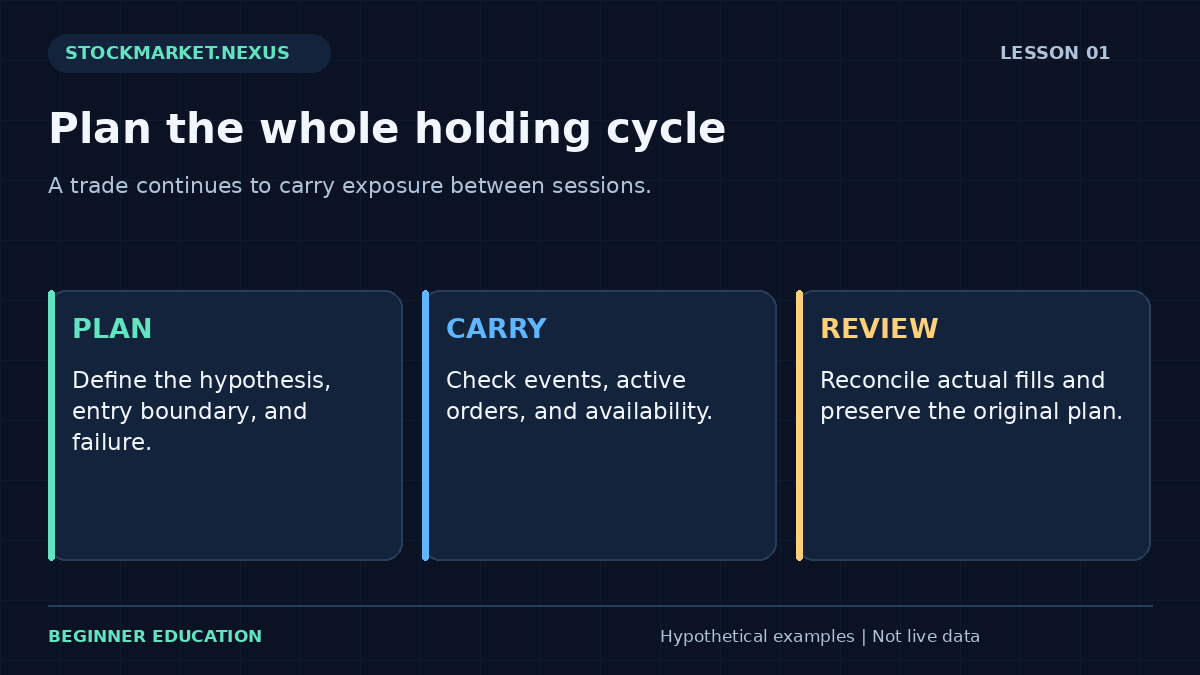
The examples in this guide use fictional, fully paid long-stock positions. They introduce a process rather than a recommendation to buy a security or adopt a particular risk percentage. The important difference from an intraday exercise is that new information can arrive while the regular market is closed. A position continues to carry exposure even when its owner is asleep, working, or unable to submit an instruction.
1. Choose a holding thesis before choosing a stock
Start by describing the kind of movement the plan is trying to observe. One hypothesis might be a recovery from a pullback within a rising daily trend. Another might be a breakout from a completed consolidation. These are different explanations with different failure conditions. Calling every attractive chart a swing trade makes later review difficult because there is no stable definition to evaluate.
Write a conditional sentence: if the specified daily structure remains intact and an entry condition occurs within the acceptable price range, the candidate may qualify. Then write the opposite sentence: if the structure fails, the event calendar becomes unacceptable, or the entry becomes too expensive, the candidate no longer qualifies. A complete plan must be able to produce a decision to pass.
Avoid choosing a holding period solely because it sounds convenient. A five-session idea can fail on its first morning or remain unresolved after five sessions. The plan needs both price-based invalidation and a review deadline. These provide a way to distinguish an active hypothesis from a position that is being held indefinitely because selling would acknowledge a loss.
2. Separate swing trading from investing and day trading
A long-term investment thesis may depend on business development across years. A swing-trade hypothesis usually depends on a nearer-term price structure and a shorter decision window. Moving between those explanations after a loss changes the purpose of the position. It does not repair the original trade. Record a change in mandate explicitly rather than treating it as a harmless extension.
Day trading generally seeks to close the relevant position within the same session. Swing trading deliberately accepts exposure between sessions. That can reduce the need to watch every minute, but it introduces different operational demands: overnight gaps, earnings announcements, order duration, and scheduled account reviews. Less screen time does not mean less need for preparation.
The Trading Basics learning path introduces quotes, account types, orders, and execution. Those mechanics still apply to a position held for several days. An extra night does not make a limit order certain to fill or turn a stop trigger into a guaranteed sale price. Build on those foundations before adding chart-based rules.
3. Establish whether the routine is feasible
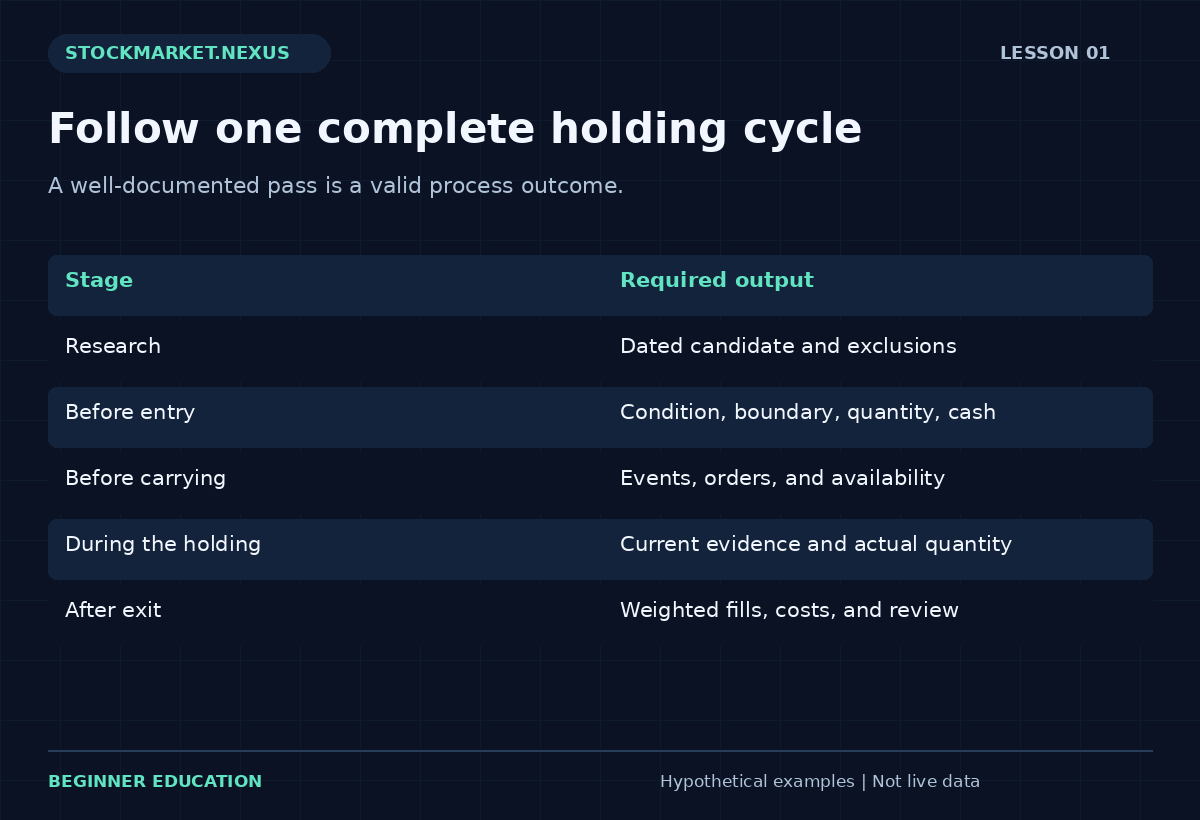
Decide when the position can realistically be reviewed. A person who can inspect the account only after the regular close needs a different monitoring routine from someone who can respond during the session. Specify the time zone, the data source, and whether decisions use completed daily bars or intraday information. Otherwise, a written end-of-day plan may quietly become a series of impulsive midday interventions.
Create an exception procedure for an unavailable review window. This might mean declining a new candidate when travel, illness, or work prevents necessary checks. It should not mean assuming that an alert will solve every problem. Alerts can be delayed, ignored, or based on a data feed different from the broker's execution environment.
Also check the practical account mechanics. Identify settled cash, existing holdings, open orders, and any borrowing permissions. A displayed buying-power figure is not a personal affordability assessment. The swing-trading account and order guide turns those checks into a transaction ledger and an order-review routine.
4. Build a small observation list
An observation list should make decisions easier, not create pressure to trade. Start with securities whose identity, ordinary trading activity, and event calendar can be verified. Record the exchange, ticker, price source, and whether the instrument is an ordinary share or a more complex product. A similar-looking ticker can refer to an entirely different instrument.
For each candidate, write one reason it deserves further study and one condition that would remove it. A candidate might have a readable consolidation but an earnings release before the next review window. Another might show a clean trend but an unacceptably wide spread for the intended quantity. Neither chart quality nor an exciting headline overrides the rest of the checklist.
Keep the list small enough to update consistently. A forgotten candidate can retain an old chart annotation long after its original conditions disappear. A short, dated list with clear exclusions is more useful than dozens of symbols collected from social posts. The desired output is an organized research queue, not a prediction of tomorrow's winners.
5. Define the entry in executable terms
An entry plan needs more than an arrow drawn near support. Specify the observation, the trigger, the acceptable price boundary, and the order type. For example, a fictional plan might require a completed daily close above a consolidation boundary, followed by an entry opportunity that does not exceed a stated maximum price. The close and the next available execution price are separate observations.
A trade can meet the chart condition yet fail the price condition. If the next session opens far above the permitted entry, the correct record may be a qualified signal with no eligible execution. Do not silently substitute the previous close as a fill. That would create a paper result unavailable to the actual decision process.
Avoid changing the trigger after seeing the outcome. A rule based on a completed close must not claim an earlier intraday entry unless that earlier rule was genuinely specified. Preserve the original timestamp and the information available then. This is the foundation for honest review, whether the later move succeeds or fails.
6. Calculate quantity from both cash and planned loss
Consider a fictional entry at $40, an intended protective exit at $38, and a $60 planned price-loss allowance before costs. The entry-to-exit distance is $2 per share, so the arithmetic allowance supports 30 shares. Those shares require $1,200 of purchase cash. A cash balance below that amount would create a separate constraint even though the loss calculation supports the quantity.
The calculation describes a planned price loss, not a maximum possible loss. If the next available sale is $35 after an overnight gap, 30 shares lose $150 before explicit charges. The difference matters because a holding period includes opportunities for prices to jump past the intended exit. A narrow stop distance does not remove that exposure.
The position sizing and gap-risk lesson develops both calculations together. Keep the quantity calculation, the cash check, and a worse-exit scenario on the same decision card. Separating them across different notes makes it easier to mistake one favorable number for approval of the entire trade.
7. Write the overnight decision explicitly
Before carrying the position, check what can occur before the next review. Relevant information includes company announcements, scheduled economic releases, trading holidays, and known changes to the security. Calendar information can change, so record the source and the time of the check. An empty third-party calendar is not proof that no important information can arrive.
State whether the plan permits holding through the identified event. If it does, describe the additional uncertainty rather than assigning a precise probability without evidence. If it does not, define when and how the position must be reviewed or closed. A rule such as avoiding an earnings release is incomplete unless its timing can be acted on.
A stop may not operate in every session, and the broker's trigger rules and accepted instructions matter. Verify those details directly. The overnight question is not simply whether a protective line appears on the chart. It is whether the account contains the intended active instruction and whether the remaining unprotected scenarios are understood.
8. Review the position without rewriting its history
At each scheduled review, compare current evidence with the original plan. Has the structure remained valid? Has an event moved into the holding window? Have actual fills changed the quantity? Has the review deadline arrived? These are specific questions. Asking only whether the position is profitable encourages decisions based on emotional attachment to the entry price.
Separate a permitted adjustment from a rule change. A trailing exit may be allowed to move according to a prewritten method, while widening an exit because the price has fallen may violate the plan. Both actions change the order, but they have different meanings. Record the reason and the evidence rather than labeling every adjustment as risk management.
If an order must be changed, verify cancellation and replacement status. A requested cancellation is not a confirmed cancellation, and a partially filled instruction can leave a different holding from the one expected. The account's actual quantity is the starting point for the next decision. The chart annotation is only a description.
9. Close the trade and reconcile the account
A completed chart idea is not necessarily a completed account transaction. Confirm the filled quantity, execution prices, explicit charges, and any remaining orders. If only part of a position sells, the unsold shares still need a plan. If a protective order remains after the holding is closed, resolve its status rather than assuming it disappeared automatically.
Calculate the result from weighted fills. Suppose 10 shares sell at $43 and 20 at $42.50 after a 30-share entry at $40. Gross proceeds are $1,280, the original purchase value is $1,200, and the gross price result is $80. Subtract applicable charges separately. Do not multiply all 30 shares by the best sale price.
Then classify the process. A loss can follow the rules, while a profitable trade can contain an unauthorized addition or a missed exit. Keeping outcome and process separate makes the journal more informative. Otherwise, the most recent profit becomes permission to repeat any behavior that happened to accompany it.
10. A complete practice assignment
Use the Swing Trading Practice Lab to rehearse decisions using fictional prices. Before revealing another session, record the current position, intended stop, target, and planned response to an adverse opening gap. Advance only after writing the decision. This preserves the distinction between making a choice and explaining an already-visible outcome.
For the $40 entry example, compare three exits for 30 shares: $38, $35, and $44. The price results are losses of $60 and $150, and a gain of $120, before charges. Next, reduce the quantity to 15 shares and recompute every result. Notice that smaller size changes the dollars exposed without making the future path more predictable.
Finally, write a one-page decision card containing the hypothesis, entry condition, maximum acceptable price, intended exit, quantity, cash requirement, event check, and review deadline. Add the actual execution record only after the simulated order occurs. The assignment is complete when another reader can reconstruct what was known, what was permitted, and what actually happened.
Frequently asked questions
Does swing trading require checking prices continuously? Not every method uses continuous monitoring, but every holding needs a feasible review and exception routine. The required attention depends on the instrument, order instructions, events, and rules. A method that cannot be operated within the available schedule is unsuitable for that routine regardless of how attractive its historical charts look.
Is a longer holding period automatically safer? No. It changes the sources of uncertainty. A position held overnight can encounter a gap, an announcement, or a period without accessible liquidity. Evaluate exposure and operating requirements directly rather than treating the number of holding days as a safety rating.
What should a beginner learn first? Start with instrument identity, account funding, quotes, order behavior, and honest quantity calculations. Then practice one clearly defined setup with dated decisions and realistic execution assumptions. A collection of named patterns is less useful than being able to explain and reconcile one complete trade.
Sources and further reading
Charles Schwab: Swing trading overview provides background on the holding horizon. Investor.gov: Types of orders explains execution instructions. The worked examples and decision framework above are original educational illustrations, not historical performance results.