

Risk Management · Lesson 07 of 15 · Reviewed November 10, 2026
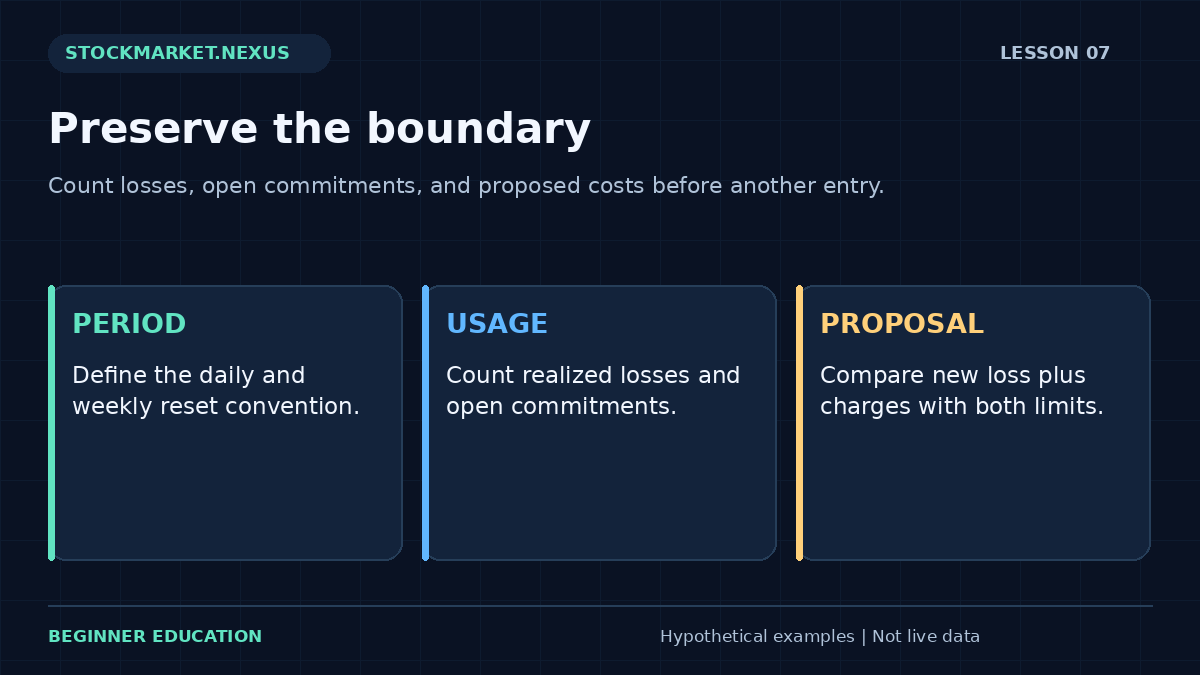
A daily or weekly loss boundary is a prewritten control for reviewing new exposure. It can help organize a pause decision, but it does not cap the loss on positions already open. A useful boundary needs a defined period, a loss convention, treatment of open commitments, and a rule for whether profits replenish capacity.
This lesson uses a conservative teaching convention: realized loss usage accumulates separately from profits, and planned open commitments plus a proposed new scenario are compared with both daily and weekly boundaries. The exercise reports whether the entered proposal fits those arithmetic constraints. It does not recommend boundary amounts or authorize a trade.
1. Define the period and reset time
A calendar day, a market session, and a rolling 24-hour window are different periods. A weekly boundary also needs a start and end time. If the reference resets while positions remain open, the treatment of those positions must be stated. Resetting a counter does not eliminate their exposure.
Record the time zone and whether after-hours activity belongs to the preceding or following period under the chosen policy. The point is consistency, not selecting the most favorable definition after a loss. A boundary that changes whenever it becomes restrictive is difficult to review honestly.
The worksheet accepts current usage figures and does not infer dates or reset them automatically. It models a single decision snapshot. A full operational system would require a reliable ledger and explicit handling of corrections, fees, and open positions across periods.
2. Choose a realized-loss convention
Net daily profit and accumulated realized losses answer different questions. A session with a $100 gain followed by a $100 loss has net zero before costs, but it has still experienced $100 of realized loss. A policy can choose how those outcomes affect capacity, but the choice must be visible.
This worksheet uses entered realized loss usage and does not add profits back. The convention is deliberately simple so a profitable earlier trade does not silently enlarge the hypothetical boundary. It is a teaching policy, not a universal rule for every account.
Charges must be included consistently. If realized-loss usage already includes completed-trade charges, do not add them a second time. Proposed charges are entered separately for the new scenario. A ledger should distinguish estimates from confirmed costs.
3. Include planned open commitments
Open positions can create losses before another review is possible. A boundary check that subtracts only realized losses may therefore overstate available capacity. The exercise subtracts a supplied planned open-risk total from both the daily and weekly remaining amounts.
That total is itself conditional on its exit assumptions. Several positions can gap together and exceed it. The capacity check is therefore a planning snapshot rather than a guaranteed account-loss limit. A separate joint stress review remains necessary.
The aggregate open-risk lesson develops that total explicitly. The boundary worksheet assumes the learner has already reconciled the open commitments and supplies the result as one input.
4. Compare a proposal with both constraints
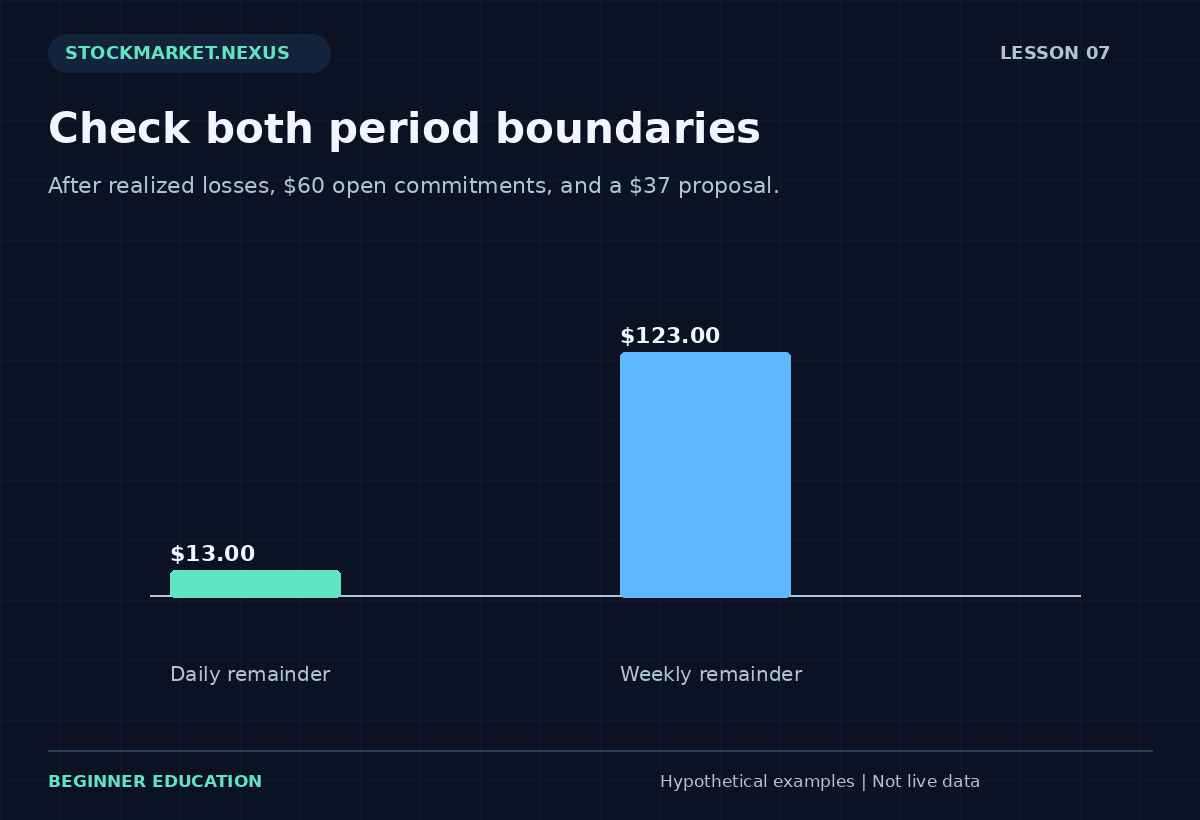
Suppose daily boundary is $150, daily realized loss usage $40, weekly boundary $400, weekly usage $180, and planned open commitments $60. Remaining daily capacity before a new proposal is $50; remaining weekly capacity is $160.
If proposed planned loss is $35 and proposed charges $2, the proposal uses $37. It fits both entered constraints, leaving $13 daily and $123 weekly. “Fits” describes arithmetic compliance with the chosen model, not personal suitability or a recommendation to proceed.
If proposed loss rises to $55 with the same charges, it exceeds daily capacity even though it still fits weekly capacity. The tighter constraint matters. A professional display shows each calculation rather than combining the two boundaries into an unexplained approval badge.
5. Distinguish pause controls from liquidation guarantees
A pause rule can block new planned entries under a chosen process. It cannot make an existing holding stop losing, ensure an exit fill, or reverse a pending transaction. The timing and implementation of any real control must be understood separately.
An alert that tells a person to review exposure is different from an automatically enforced order restriction. A paper worksheet is different again. The exercise does not connect to a broker or prevent transactions; it teaches the capacity arithmetic.
Review stop-order execution risk for the distinction between intended protection and actual account state. A boundary becomes more useful when its operational limits are explicit.
6. Use the dedicated capacity exercise
Open the Lesson 7 boundary exercise. Enter daily boundary 150, daily usage 40, weekly boundary 400, weekly usage 180, open commitments 60, proposed loss 35, and proposed charges 2. Predict the two remaining capacities and the post-proposal balances.
Raise proposed loss to 55. The daily post-proposal balance becomes negative $7 while the weekly balance remains positive. The tool should state that the proposal exceeds at least one entered boundary. It should not hide the excess by flooring every displayed balance to zero.
Next raise weekly usage to 350. The weekly constraint becomes restrictive too. These changes illustrate why a single daily counter is not a complete view of a multi-period policy. The inputs are fictional and do not prescribe a particular loss budget.
7. Handle profits, reversals, and corrections honestly
Under this exercise’s convention, profits do not replenish usage. If a different policy permits netting, record it as a different rule and test its behavior. Do not switch between net and gross-loss conventions during the same review to make a proposal fit.
A corrected trade or refunded charge may require an audited ledger adjustment. Preserve the original entry and the correction rather than quietly editing the total. This keeps the usage figure explainable and prevents mismatches between the journal and account records.
A newly realized loss can replace a previously open planned commitment. The ledger must avoid counting the same exposure twice after reconciliation. Until the state is confirmed, uncertainty should be stated rather than resolved through optimistic assumptions.
8. Define the review that follows a boundary event
A useful pause process names the records to inspect: fills, remaining positions, pending orders, costs, event changes, and rule compliance. It can also require a new written plan before later activity resumes. The worksheet itself cannot enforce that workflow.
A boundary event may result from ordinary unfavorable outcomes, a single gap, or repeated deviations from the plan. Those causes should not receive the same explanation automatically. Diagnose the process before selecting a response.
The risk journal lesson helps separate behavior from outcome. A pause is most useful when it creates a structured review rather than a ritual followed by an immediate attempt to recover losses.
9. Case review: a profitable morning does not rewrite the rule
A fictional policy sets daily accumulated-loss usage at $150 without profit replenishment. A learner first gains $200, then realizes a $100 loss. Under that policy, $100 of usage has occurred even though the session remains net positive before other costs. The remaining boundary amount is $50 before open commitments.
If the learner instead subtracts the profit and declares $250 of new loss capacity, the policy has changed. That may be a different model worth studying, but it is not compliance with the original one. Preserve the distinction in the journal.
For practice, write a small event sequence and update realized-loss usage after each completed loss while leaving profits in a separate field. Then add open commitments before evaluating a new proposal. This makes the chosen convention concrete and prevents a favorable net balance from concealing how the boundary is actually defined.
Review challenge: a realized loss replaces an open commitment
A snapshot contains $40 daily realized-loss usage and $60 planned open commitments. One of those open commitments later closes with a $30 realized loss and had previously contributed $25 to the open total. After reconciliation, realized usage becomes $70 and remaining planned open commitments become $35.
Adding the $30 realized loss without removing the old $25 commitment would count part of the same exposure twice. Removing the commitment without recording the realized loss would omit exposure already experienced. The ledger must update both sides from confirmed state.
If the actual loss exceeds the earlier $25 plan, the difference should remain visible. It may reflect execution deterioration, changed assumptions, or a rule deviation. Do not force the realized figure to match the earlier plan simply to keep the boundary calculation tidy.
For practice, update the snapshot before evaluating a new proposal. State the daily and weekly conventions, including whether the realized charge is already included. A capacity worksheet is only as reliable as the ledger supplied to it. Its professional value comes from making the components clear, not from displaying an approval-like label when the underlying totals are stale or inconsistent.
A complete practice record: assumptions, calculation, and review
Start the exercise by copying its inputs into a short record before pressing Calculate. Identify every unit and denominator: dollars, shares, percentages, price units, or a count of completed observations. Write the valuation time and clarify whether the values are fictional, historical, or confirmed transactions. The defaults in this course are fictional teaching examples. Their purpose is to make the arithmetic reproducible, not to recommend a position, percentage, boundary, or financing arrangement for a particular person.
Name the assumption that has the greatest effect on the answer. In one exercise it may be an exit fill; in another it may be the portfolio value, a shared shock, a cost, or the definition of the risk unit. A precise result can be highly sensitive to one uncertain input. State that sensitivity in plain language rather than allowing a clean screen to imply certainty. The calculator can enforce numerical consistency, but it cannot verify that the source data or chosen policy fits a real account.
Predict the result of one controlled change before calculating again. Keep every other input fixed. Explain whether the change affects a numerator, denominator, quantity constraint, cost, or scenario branch. Then compare the displayed result with your prediction. If they differ, return to the definition and arithmetic before inventing a market explanation. This method teaches the relationship among the inputs and prevents experimentation from becoming a search for a reassuring output.
Test a boundary case deliberately. Ask what happens when no whole share fits, a denominator becomes zero, a list is incomplete, a quantity exceeds the holding, or a scenario no longer matches the required price ordering. A validation message is useful evidence about the model’s scope. Do not replace a rejected value with an unrelated number simply to obtain an answer. First identify the violated assumption and decide whether this exercise is the appropriate model for the question.
Keep intended actions separate from confirmed states. A submitted order is not a completed fill, a cancellation request is not necessarily a canceled instruction, and a chart reference is not an available transaction price. For a paper exercise, state the hypothetical execution assumption. For a completed transaction record, use actual quantities, prices, charges, and status. Reconcile partial fills and remaining instructions so the ledger describes the exposure that exists rather than the exposure that was intended.
Write both the ordinary scenario and an adverse alternative when the model permits it. Preserve the original quantity while testing a worse outcome unless the purpose is explicitly to design a new plan. Label any revised plan with its own time and assumptions. A stress case is one selected possibility; it is not automatically the worst conceivable outcome or an estimate of probability. Missing information should remain labeled as missing rather than being converted into a zero or a favorable assumption.
Review the result on two separate dimensions. The first is outcome: what net dollars or normalized result occurred under the stated convention? The second is process: were the original definitions, constraints, and reconciliation steps followed? A favorable outcome does not prove a deviation was sound, and a loss does not prove that correct arithmetic was wrong. This separation helps a beginner identify a specific improvement instead of responding to every result with a new rule.
Finish with a concise explanation containing the observation, calculation, interpretation, and limitation. Another reader should be able to reproduce the important numbers without guessing what the fields mean. Preserve the original record, later revisions, and unfavorable examples. If extending the exercise into a historical or forward paper study, define the eligible sample and review horizon before collecting outcomes. A selected group of attractive examples cannot establish the reliability of a process. The strongest learning result is a clearer, auditable decision routine, including a clear reason when an example remains unresolved or does not fit the entered constraints.
Sources and model scope
Primary investor-education background supplies additional context. The numerical cases, graphics, and worksheets here are original fictional teaching examples. Every calculation depends on its stated convention; no worksheet determines personal suitability, guarantees execution, or establishes future returns.