


Risk Management · Lesson 03 of 15 · Reviewed November 10, 2026
A stop price is an activation reference, not a guaranteed transaction price. That distinction is central to risk management because a plan often calculates loss using the stop reference while the account ultimately experiences actual fills. A protective instruction can be useful and still leave execution uncertainty.
This lesson compares a planned long-share exit with an actual or hypothetical fill and traces the dollar difference. It also distinguishes stop-market and stop-limit mechanics, partial execution, and confirmed account state. The dedicated exercise does not submit orders or simulate a broker’s specific trigger policy.
1. Separate activation from execution
A stop order generally becomes a market order when its activation condition is met. The resulting order seeks execution against available liquidity, so the fill can differ from the stop price. Fast markets, gaps, and changing quotes can make the difference substantial.
The exact activation convention can depend on the broker and product. A service may use particular trade or quote conditions and may treat sessions differently. Before relying on an instruction, the user must understand its actual terms rather than assuming every platform uses the same trigger.
The worksheet does not infer those terms. It accepts a planned reference and a separate fill solely to show the cash consequences. The distinction remains useful regardless of which specific activation policy a real broker applies.
2. Understand the stop-limit tradeoff
A stop-limit adds a limit instruction after activation. The limit controls the worst permitted execution price under that order’s terms, but it introduces the possibility that the order will not execute. Price can move beyond the limit and leave the position open.
For a fictional sell stop-limit, a stop at $48 and limit at $47.80 do not guarantee a sale near either value if the next available market is around $45. A later recovery might permit execution, or the holding might remain exposed. The full path and order status matter.
It is therefore misleading to say that a stop-limit guarantees a maximum position loss. It constrains permitted execution for that instruction, not the future market value of an unfilled holding. A risk review must consider both price deterioration and nonexecution.
3. Calculate the planned and filled scenarios separately
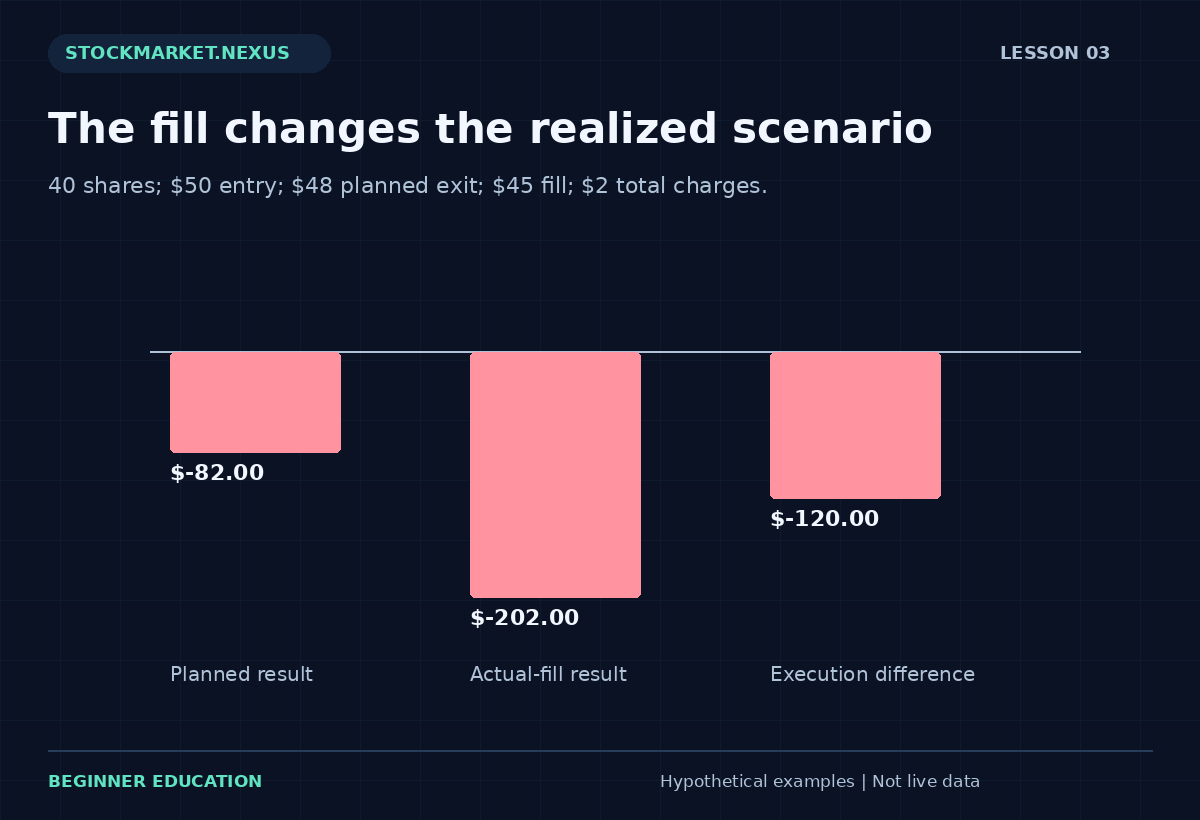
Suppose entry is $50, planned exit $48, actual exit $45, quantity 40, and total charges $2. Planned net result is 40 × ($48 − $50) − $2 = −$82. Actual-fill net result is 40 × ($45 − $50) − $2 = −$202.
The actual result is $120 worse because the fill is $3 lower across 40 shares. This execution difference is distinct from the planned price loss and charges. Naming each component helps a beginner understand how a modest-looking price difference becomes a larger account effect.
The exercise accepts any nonnegative actual exit, including a better fill, but labels the result as a comparison rather than a prediction. A better hypothetical fill does not establish that such improvement was available or that a particular order would have obtained it.
4. Distinguish a submitted instruction from a confirmed state
Submitting a stop, modification, or cancellation request does not by itself prove the requested state exists. A request can be pending, rejected, partially executed, or completed. The account record should use confirmed status and actual fills rather than the learner’s intention.
Cancel-and-replace workflows deserve particular attention. If an old instruction fills while a replacement is being processed, the resulting holding can differ from the intended plan. A professional operational checklist includes quantity reconciliation and confirmation of any remaining instructions.
The general order-types lesson explains basic mechanics. Risk management adds the question of what exposure remains when the instruction does not behave like the simplified chart assumption.
5. Account for partial fills and remaining shares
If only 15 of 40 shares sell, the account still holds 25. The realized result on the sold portion does not settle the remaining position’s exposure. A ledger should show the completed fill, the remaining quantity, and the status of any outstanding instruction.
Multiple fills also require a weighted average, not a simple average of displayed prices. Selling 10 shares at $48 and 30 at $46 produces a different weighted exit from selling equal quantities at both prices. The quantities determine the cash proceeds.
The liquidity and partial-fill lesson provides a dedicated weighted-fill exercise. This stop comparison assumes the entire entered quantity exits at the supplied actual or hypothetical price.
6. Use the dedicated execution-risk exercise
Open the Lesson 3 stop-execution exercise. Enter entry 50, planned exit 48, actual exit 45, shares 40, and charges 2. Predict planned result minus 82, actual result minus 202, and execution difference minus 120 before calculating.
Change actual exit to 47.50. The actual result becomes minus 102, which is $20 worse than planned. Next use 48.20. The result is $8 better than planned under the supplied full-fill assumption. The worksheet shows the arithmetic without claiming either fill is guaranteed.
Try a planned exit above entry. That does not fit this lesson’s protective long-loss scenario and should be rejected. A zero share quantity also does not represent a completed position exit in this exercise. Clear input rules keep the comparison coherent.
7. Recognize session and event risks
An instruction’s availability and operation can differ across regular and extended sessions. A price change outside the instruction’s active conditions can create exposure before the next eligible activation or fill. Read the specific service terms rather than assuming continuous protection.
Trading halts and event-driven gaps create another distinction between a drawn line and an available transaction. If no execution is possible at the reference, the market can reopen elsewhere. The worksheet cannot estimate that reopening price or its probability.
The overnight and event-risk lesson develops scenario testing around this uncertainty. A useful plan includes adverse cases rather than assuming the absence of continuous trading is a minor inconvenience.
8. Avoid false reassurance from order labels
The phrase stop-loss can sound like a contractual cap on loss, but its practical meaning depends on the order mechanism and market. A label is not enough. A beginner should be able to explain the trigger, resulting instruction, session, quantity, and nonfill or adverse-fill possibility in plain language.
A mental stop or alert has different operational requirements from a broker-held instruction. It depends on observation and a later decision or submission. Treating an alert as though it were already an executable order hides timing and availability risks.
No order choice removes every tradeoff. The professional task is to understand which uncertainty is being controlled and which remains. A controlled price can come with nonexecution risk; an execution-seeking instruction can come with uncertain price.
9. Case review: the limit remains unfilled
A fictional 40-share holding has entry $50 and a sell stop-limit with activation $48 and limit $47.80. The next eligible market opens around $45. The stop condition may activate under the broker’s terms, but the sell limit may not execute. The position still requires a current exposure assessment.
Do not enter $47.80 as an actual fill merely because it appears in the order ticket. A completed trade needs a confirmed transaction record. If the study lacks enough information to determine whether execution occurred, mark the case unresolved or apply a documented conservative assumption.
For practice, write separate lines for intended protection, confirmed order status, realized fills, and remaining shares. This small ledger prevents the most consequential misunderstanding in the lesson: a protective reference or submitted instruction is not the same thing as a closed position at a guaranteed price.
Review challenge: a better fill is still only a supplied case
Use entry $30, planned protective exit $28, actual or hypothetical exit $27.60, quantity 25, and charges $2. Planned net result is minus $52. The supplied fill produces minus $62, an additional $10 loss. The difference is 25 shares times minus $0.40; charges are unchanged between the branches.
Now change only the fill to $28.10. The result improves by $2.50 relative to the plan. That favorable arithmetic does not establish that a particular order would have received improvement. The worksheet accepts a supplied completed-fill scenario, while the order’s real activation and routing require separate evidence.
Write three distinct records: the original protective instruction, the confirmed or hypothetical fill, and the resulting position status. If the order did not execute, there is no completed-fill result to enter merely because a limit price appeared in the ticket. The remaining holding requires a current scenario review.
For a journal comparison, keep the benchmark and charges fixed across cases. Selecting a new planned reference after seeing the fill can make execution look better or worse without changing the transaction. A consistent comparison is more useful than an attractive slippage figure assembled retrospectively. The central control is accurate state reconciliation, not confidence in the order label.
A complete practice record: assumptions, calculation, and review
Start the exercise by copying its inputs into a short record before pressing Calculate. Identify every unit and denominator: dollars, shares, percentages, price units, or a count of completed observations. Write the valuation time and clarify whether the values are fictional, historical, or confirmed transactions. The defaults in this course are fictional teaching examples. Their purpose is to make the arithmetic reproducible, not to recommend a position, percentage, boundary, or financing arrangement for a particular person.
Name the assumption that has the greatest effect on the answer. In one exercise it may be an exit fill; in another it may be the portfolio value, a shared shock, a cost, or the definition of the risk unit. A precise result can be highly sensitive to one uncertain input. State that sensitivity in plain language rather than allowing a clean screen to imply certainty. The calculator can enforce numerical consistency, but it cannot verify that the source data or chosen policy fits a real account.
Predict the result of one controlled change before calculating again. Keep every other input fixed. Explain whether the change affects a numerator, denominator, quantity constraint, cost, or scenario branch. Then compare the displayed result with your prediction. If they differ, return to the definition and arithmetic before inventing a market explanation. This method teaches the relationship among the inputs and prevents experimentation from becoming a search for a reassuring output.
Test a boundary case deliberately. Ask what happens when no whole share fits, a denominator becomes zero, a list is incomplete, a quantity exceeds the holding, or a scenario no longer matches the required price ordering. A validation message is useful evidence about the model’s scope. Do not replace a rejected value with an unrelated number simply to obtain an answer. First identify the violated assumption and decide whether this exercise is the appropriate model for the question.
Keep intended actions separate from confirmed states. A submitted order is not a completed fill, a cancellation request is not necessarily a canceled instruction, and a chart reference is not an available transaction price. For a paper exercise, state the hypothetical execution assumption. For a completed transaction record, use actual quantities, prices, charges, and status. Reconcile partial fills and remaining instructions so the ledger describes the exposure that exists rather than the exposure that was intended.
Write both the ordinary scenario and an adverse alternative when the model permits it. Preserve the original quantity while testing a worse outcome unless the purpose is explicitly to design a new plan. Label any revised plan with its own time and assumptions. A stress case is one selected possibility; it is not automatically the worst conceivable outcome or an estimate of probability. Missing information should remain labeled as missing rather than being converted into a zero or a favorable assumption.
Review the result on two separate dimensions. The first is outcome: what net dollars or normalized result occurred under the stated convention? The second is process: were the original definitions, constraints, and reconciliation steps followed? A favorable outcome does not prove a deviation was sound, and a loss does not prove that correct arithmetic was wrong. This separation helps a beginner identify a specific improvement instead of responding to every result with a new rule.
Finish with a concise explanation containing the observation, calculation, interpretation, and limitation. Another reader should be able to reproduce the important numbers without guessing what the fields mean. Preserve the original record, later revisions, and unfavorable examples. If extending the exercise into a historical or forward paper study, define the eligible sample and review horizon before collecting outcomes. A selected group of attractive examples cannot establish the reliability of a process. The strongest learning result is a clearer, auditable decision routine, including a clear reason when an example remains unresolved or does not fit the entered constraints.
Sources and model scope
Primary investor-education background supplies additional context. The numerical cases, graphics, and worksheets here are original fictional teaching examples. Every calculation depends on its stated convention; no worksheet determines personal suitability, guarantees execution, or establishes future returns.