

Options Trading · Lesson 11 of 15 · Reviewed November 10, 2026
A cash-secured put combines a short put with cash reserved to meet the purchase obligation under the contract. The arrangement addresses funding capacity, not the possibility of a loss. If assigned after a large decline, the writer can be required to buy shares at a strike far above their current value.
This lesson uses one fictional standard $45 put sold for $2 per share with a 100-share deliverable. The strike purchase obligation is $4,500, while the premium receipt is $200 before charges. Keep those figures separate before calculating the combined expiration economics.
1. Identify the obligation before the premium yield
Selling the put to open creates a short option. Assignment involves buying the deliverable at the strike. Cash reserved for that purchase should be evaluated under the broker's actual requirements. Do not assume that every platform's collateral display uses an identical treatment of premium or other account assets.
The fact that the trader initially liked the stock below a certain price does not guarantee that buying remains desirable after adverse information. A major business change can occur while the obligation remains open. The contract does not ask whether the writer's opinion has changed before assignment.
The exercise and assignment lesson explains the resulting share transaction. The decision card should identify the intended post-assignment holding and the resources needed to manage it, rather than treating assignment as a minor administrative event.
2. Calculate simplified expiration profit and loss
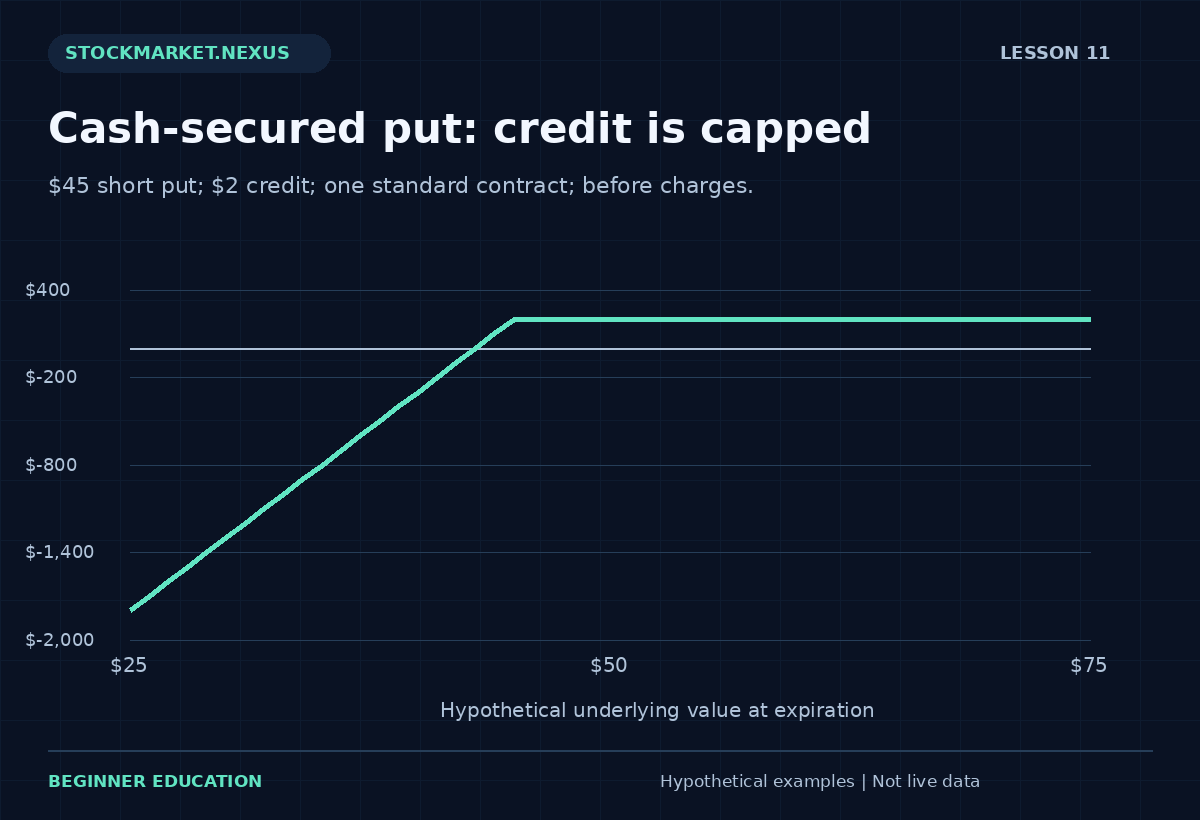
For the short put, premium received is reduced by put intrinsic value in the expiration model. At an underlying value at or above $45, the modeled option profit is the $200 premium before charges. At $40, the $5 intrinsic obligation per share exceeds the $2 premium, producing a $300 loss per standard contract.
The expiration breakeven is $43 before charges. At an underlying value of zero, the modeled loss is $4,300: strike minus premium, multiplied by 100. The received $200 is the maximum modeled gain from the option, not the maximum exposure.
At $44, the put is in the money but the simplified net result is still a $100 gain before charges. Moneyness and writer profitability are different fields. An account can also face assignment despite a positive premium-based economic result, so a profit calculation does not remove the need to understand the purchase transition.
3. Evaluate the use of reserved cash
Cash committed to the obligation may not be available for unrelated purchases under the account's rules. Compare the full required resources and holding period rather than annualizing a short premium receipt as though the same outcome can be repeated continuously without interruption or loss.
A quoted premium divided by strike cash is a simple ratio, not a forecast return. It omits adverse outcomes, changing opportunities, charges, and the possibility that assignment leaves an ongoing stock holding. Multiplying that ratio across a year can create an unsupported impression of stable income.
The position-sizing and journal lesson keeps collateral, premium, and actual account results separate. A professional review reports what happened over the observed dates rather than presenting an entry credit as a guaranteed yield.
4. Include early assignment and event exposure
An American-style short put can be assigned before expiration. A deeply in-the-money option, changing extrinsic value, and other conditions can affect incentives, but the writer does not control the holder's choice. Verify the broker's procedure and the account's ability to fund the deliverable.
Scheduled announcements can produce a stock gap and a different option quote. A limit order to buy back the put may not fill at the desired premium. A mental rule to close before a certain loss still depends on attention and an available execution. Cash security does not make the option's value path smooth.
The implied-volatility and event lesson explains why premium levels around announcements require more context. A larger credit can accompany larger uncertainty rather than a free improvement in the trade.
5. Treat closing, assignment, and rolling as different endings
Buying to close the put can remove the short obligation if the transaction completes. The realized option result is premium received minus premium paid back and applicable charges. It is not automatically the full opening credit.
Assignment changes the account into the specified stock purchase. The original premium remains relevant to the economic ledger, but the resulting shares continue to carry exposure. A later stock recovery or decline belongs in the combined record if the strategy includes holding those shares.
A roll closes one short contract and opens another. Preserve the realized old result and the new obligation separately. A net credit on a roll does not prove that a loss has disappeared or that the new holding period is appropriate. The new contract needs its own event and account review.
6. Practice the obligation and the payoff together
Use the cash-secured-put exercise to calculate premium, strike purchase value, expiration breakeven, modeled maximum gain, and downside at zero. Compare an unchanged stock with a substantial decline rather than showing only the premium-retention scenario.
For the $45 strike and $2 premium, test terminal values of $50, $44, $40, and zero. Explain the difference between the modeled result and the shares that may be acquired under assignment. The account transition and the economic payoff should both be understandable.
Finish by writing whether a 100-share purchase at $45 remains acceptable under the hypothetical mandate after new information. A calculator cannot answer that judgment question, but it can make the dollar obligation visible enough that the question is not overlooked.
## Worked expiration table and purchase obligation
For one standard $45 put sold at $2, terminal underlying values of $50, $45, $44, $43, and $35 produce simplified option results of plus $200, plus $200, plus $100, zero, and minus $800 before charges. The favorable result is capped by the credit, while the adverse result grows as the stock declines below breakeven.
The $44 row shows a positive modeled net result even though the put is in the money. Assignment can still involve buying 100 shares for $4,500. Profitability under a premium calculation does not eliminate the share transaction. The account needs a plan for what happens after purchase, not only a forecast that the put will expire.
At zero, the modeled downside is $4,300 before charges. That boundary follows from a zero-value stock and the received premium under the standard assumptions. It is not an assessment that such an outcome is likely, nor does the cash reserve make a large decline economically harmless.
Compare a put entry with a stock purchase carefully
A put writer may describe the strike as a preferred purchase price. The contract, however, creates an obligation over a period during which information can change. A stock purchase decision made later with new information is not identical to the obligation accepted earlier. The premium compensates for a contingent exposure; it is not simply a discount coupon with no tradeoff.
If the stock rises and the put ends without assignment, the writer retains the premium under the model but does not own the shares from that contract. If the stock falls sharply, assignment can occur at the strike despite the less attractive current information. Both branches belong in the comparison.
A fair study uses consistent dates, charges, distributions, and account resources. It should not compare the put's best branch with a stock purchase's worst branch or annualize only the premium-retention periods. The whole sequence is the evidence needed to evaluate the method.
Reconcile the stock after assignment
Suppose assignment purchases 100 shares at $45 after the stock falls to $35. The strike cash is $4,500 and the current reference value is $3,500. The $200 original premium remains in the combined economics, but it does not erase the substantial decline in the acquired holding's value.
If the shares are later sold at $37, record that actual sale and the original premium under the chosen combined strategy convention. Do not treat the option as a successful income trade while omitting the stock loss it created. The accounting window should be defined before outcomes are selected.
Any new call sold against the shares is another transaction with its own terms and obligations. It can be part of a broader method, but it does not retroactively change the earlier put result. Preserve the stages so the record can distinguish original exposure, assignment, and later management.
Audit collateral before increasing contract quantity
Moving from one to three standard $45 puts changes the strike purchase value from $4,500 to $13,500. The premium at $2 becomes $600, but the share obligation becomes 300 shares. A small increase in the contract-count field can therefore create a substantial change in required resources.
Review overlapping exposure if several puts reference related companies or the same event. Different tickers do not necessarily create independent adverse scenarios. Cash capacity and economic concentration should be evaluated separately. Funding every assignment does not guarantee that the resulting combined portfolio is acceptable.
The practice exercise should end with a plain-language obligation statement and a separate payoff result. A learner who can explain both has a stronger foundation than one who focuses only on the percentage credit relative to reserved cash. The contract's purchase obligation is the defining feature, not an optional complication.
## How to complete and review the lesson exercise
Start by writing the contract identity and the calculation's time horizon before entering numbers. A quoted premium, a hypothetical expiration value, and a strike-related cash transaction are different inputs. State which one the exercise uses. This prevents a correct arithmetic operation from answering the wrong question. The worksheet should support the lesson's definitions rather than encourage the visitor to infer a real trade from an attractive output.
Next, translate every per-share figure into the stated contract units. Use the actual multiplier and deliverable when studying a real specification; the lesson exercises intentionally use clearly labeled standard examples. Keep quantity separate from price. Increasing contract count changes total dollars and obligations without improving the underlying hypothesis. A small premium displayed on a chain can therefore become a material aggregate amount when multiplied across several contracts.
Use three input checks before interpreting the result. First, confirm that the option type and position direction match the intended lesson. Second, confirm that the premium, strikes, and quantity are internally coherent under the exercise's model. Third, distinguish a supplied scenario from an estimated probability. A table of possible outcomes does not assign odds to its rows, and a local sensitivity calculation does not forecast which input change will occur.
Record charges under one consistent convention. If actual entry and closing premiums already reflect the bid and ask, do not subtract the same spread again as an additional explicit fee. If the exercise begins with reference prices instead, label any separate friction assumption. The distinction is especially important when comparing several examples: a strategy should not receive favorable midpoint fills while an alternative is evaluated with less favorable executable quotes.
After calculating, describe the account state in plain language. State whether the model refers to an owned option, a short obligation, a matched combination, a completed premium transaction, or a possible underlying purchase or delivery. A numerical result is incomplete if the learner cannot identify what remains held or owed. Exercise and assignment can create a different position from the one shown on the original option payoff chart.
Repeat the exercise with one adverse change and one favorable change while keeping the other supplied inputs fixed. This is a controlled comparison for learning mechanics, not evidence of a real-market distribution. Preserve both results. Do not remove an unfavorable example because it makes the strategy less appealing, or reinterpret the original terms after seeing which alternative would have performed better.
Finally, separate the model's conclusion from the facts it does not establish. A simplified expiration calculation can explain economic geometry without reproducing early exercise, broker liquidation, unavailable execution, taxes, dividends, financing, or every temporary account state. A Greek worksheet can teach units without implementing a complete pricing model. The relevant omissions are specific limitations of the exercise, not reasons to ignore the calculation or to treat it as more complete than it is.
A useful review contains the original inputs, the formula or rule applied, the contract-dollar result, the remaining account-state question, and one correction if an error occurred. Keep process compliance separate from whether the chosen scenario was profitable. The objective is a reproducible explanation that another reader can audit. Repeating a known example can improve fluency, but it does not certify real-money readiness or establish future returns.
## Sources and further reading
Primary educational reference provides background. Review the OCC options disclosure document for standardized-option characteristics and risks. Numerical examples and worksheets in this lesson are fictional educational illustrations.