

Options Trading · Lesson 08 of 15 · Reviewed November 10, 2026
Implied volatility is an input inferred from option prices under a pricing model. It is not a direct forecast of direction or a guarantee about the next realized move. Around an event, premiums can reflect changing uncertainty, and a later reduction in that uncertainty can affect the option even when the underlying moves in the anticipated direction.
This lesson uses fictional model sensitivities and premiums. It separates an illustrative volatility effect from a complete market revaluation. The goal is to explain competing influences and event exposure without presenting a simple number as a reliable earnings prediction.
1. Distinguish implied from realized volatility
Implied volatility is derived from current option pricing under assumptions. Realized volatility summarizes observed historical price variation under a chosen calculation. Their time windows and meanings differ. A high implied figure does not establish that the next stock move will be upward or that realized movement must match it.
Compare like with like when using historical context. The interval, annualization convention, data source, and product can affect interpretation. A number copied from one expiration should not automatically describe every strike and expiration on the chain. Different contracts can carry different implied values.
The option-chain lesson emphasizes identity and timestamps. Those controls apply here too. A stale implied-volatility field paired with a current premium can produce a misleading explanation of the contract's state.
2. Identify the event window explicitly
Record the event source, expected or confirmed timing, and whether the intended holding crosses it. Company earnings, regulatory decisions, and other announcements can create uncertainty. A third-party calendar is a starting point, not proof that no unlisted event can occur.
The same event can affect several contracts differently because their expirations, strikes, and sensitivities differ. Do not assume that a strategy with a familiar name has neutral exposure. The actual legs and their prices determine the position, while exercise and assignment remain relevant for short legs.
The site's earnings calendar can support the initial research. Verify important issuer details directly and retain whether timing is estimated. An event plan should be able to produce a pass when the information is unresolved or the routine cannot support the necessary review.

3. Explain a simplified volatility reduction
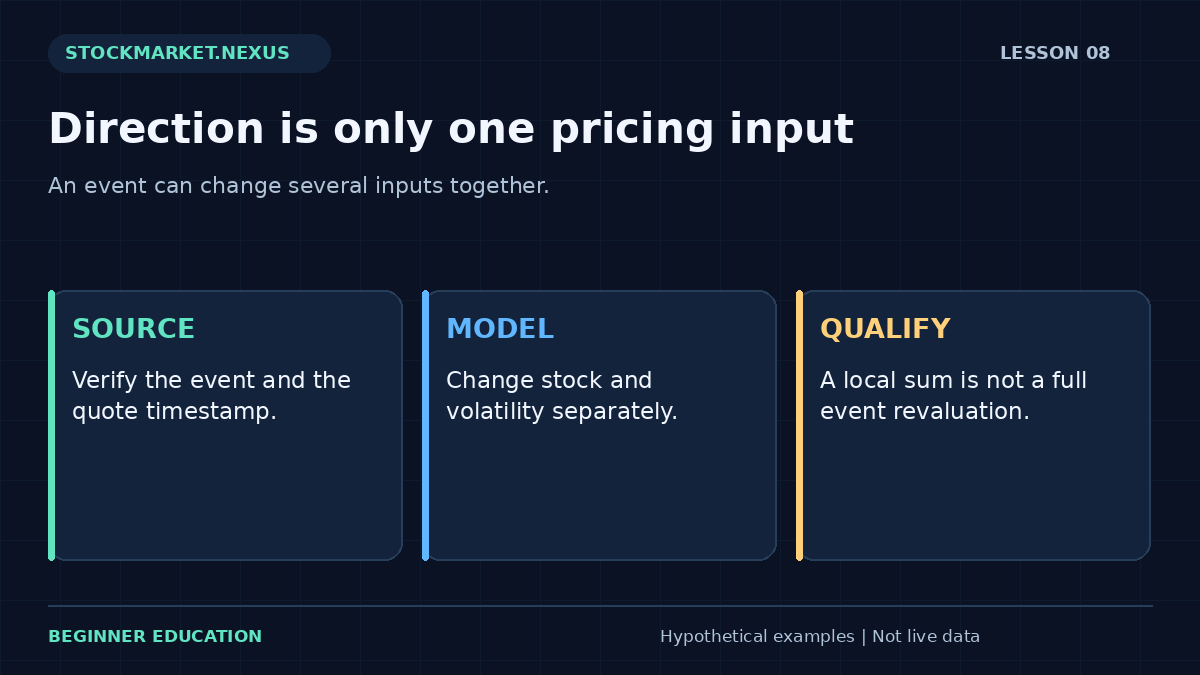
Suppose a fictional long call has delta 0.50 and vega $0.10 per share per percentage point. A $1 underlying rise contributes about $0.50 under an isolated delta approximation. A ten-percentage-point implied-volatility decline contributes about minus $1 under an isolated vega approximation. Their simple sum is minus $0.50 before other effects.
This is not a full pricing result. A ten-point change may be too large for a reliable local linear approximation, and sensitivities can change. The example exists to show why a favorable stock move need not dominate every other influence. It should not be used to quote a precise next premium.
The Greeks lesson defines those units. Keeping the output labeled approximate is essential. A clean arithmetic sum can be educational without being a sufficient model for a real event trade.
4. Avoid treating an expected-move estimate as a boundary
A model-derived expected-move figure depends on its method and inputs. It is not a wall beyond which the stock cannot travel. A realized announcement move can exceed an estimate, and an adverse gap can make available execution different from a planned trigger.
Likewise, a move inside a quoted estimate does not guarantee profit for a premium-selling structure. Entry credit, strikes, costs, timing, and actual management matter. A statement about an underlying move is not the same as a complete account-profit calculation.
If an educational study uses an expected-move convention, specify it before observing outcomes and retain exceptions. Do not choose the estimate that best explains each completed event. The study should preserve the original information and evaluate what the method actually required at the time.
5. Include short-option and spread obligations
A spread can offset some model exposure between legs, but it is not automatically protected from every event consequence. The legs can respond differently, liquidity can change, and assignment can transform the account. A theoretical expiration loss diagram assumes a particular intact structure and does not manage the broker account for the visitor.
A short American-style option can be assigned under its terms. The long leg of a spread does not necessarily act automatically in response to that assignment. The account owner needs to understand the resulting position and the broker's supported procedures rather than assume the strategy label guarantees a seamless offset.
The exercise and expiration lesson explains why event research and operational planning belong together. A favorable statistical-looking setup is incomplete if its possible account states cannot be explained.
6. Practice competing influences honestly
Use the volatility-event practice exercise to change a hypothetical stock move and an implied-volatility change independently. The worksheet uses supplied sensitivities and labels the output a local approximation. It does not estimate an actual announcement's odds or recommend a contract.
Compare a favorable directional contribution with an adverse volatility contribution. Then reverse them. This demonstrates that option pricing is multidimensional without implying that every influence is linear or independent over a large change.
Finish by writing a separate execution scenario using a supplied closing bid. That transaction result should be calculated from paid and received premiums, quantity, multiplier, and charges. The hypothetical model decomposition can help explain a possibility, while the actual ledger remains the authority for a completed trade's result.
## Worked event decomposition with a deliberately limited model
Use a fictional long call with delta 0.50 and vega $0.10 per share per percentage point. A one-dollar underlying rise contributes about fifty cents under a local delta estimate. A ten-percentage-point implied-volatility decline contributes about minus one dollar under a local vega estimate. Their simple sum is minus fifty cents before time effects, gamma, interactions, and changing sensitivities.
The large volatility change makes the approximation especially limited. The calculation demonstrates competing influences, not an accurate event revaluation. One standard contract scales the arithmetic to minus $50, but the actual available closing premium could differ materially. Display that distinction beside the output rather than burying it in a generic note.
Now reduce the volatility change to one percentage point. The isolated contribution is minus ten cents per share, and the simple sum becomes plus forty cents. The exercise shows how changing one supplied assumption changes the illustration. It does not tell the learner which assumption the next announcement will deliver.
Separate an event forecast from an option-price forecast
An analyst can correctly anticipate a business announcement while still misjudge the stock reaction. The stock reaction can be favorable while the option's executable premium disappoints. These are different forecasting problems. A contract decision requires more than confidence in one headline or directional story.
Record the event hypothesis, the expected operating window, and the contract-selection rule before the outcome. Avoid selecting the expiration or strike that later performed best. If the method excludes unresolved timing, preserve that exclusion even when the stock subsequently makes an attractive move.
A professional review can say that the event information was correct but the option outcome was unfavorable under the recorded fills. There is no need to force the account result to validate every part of the original story. Keeping the questions separate makes it easier to identify what the evidence actually supports.
Compare received premium with adverse obligations
Event-related premiums can look unusually large relative to quieter periods. That larger receipt can accompany greater uncertainty and a wider range of possible stock outcomes. A short-option structure should therefore be evaluated through its adverse payoff and account transitions, not only the opening credit.
For a fictional $50 short put sold at $3, a terminal stock value of $40 produces a $700 price-and-premium loss per standard contract before charges. The $300 received initially is not the largest possible loss. A spread can alter the intact expiration geometry, but its short leg still requires assignment planning.
The example is not an estimated event distribution. It is a conditional consequence calculation. Avoid attaching a probability to the row without suitable evidence. The worksheet's job is to show what the supplied scenario means for the account, including cases less favorable than the headline premium suggests.
Preserve event data and quote timing
Save the issuer source, confirmed or estimated timing, contract identity, quote convention, and decision timestamp. An option premium from before the release and a stock quote from afterward do not form a synchronized market snapshot. A timing mismatch can produce an explanation that looks quantitative while describing no actual available transaction.
After the event, record actual fills separately from theoretical marks. If the position remained open, label its valuation convention and the current obligation. Do not report the entire opening credit as realized profit merely because uncertainty fell. Closure or settlement still needs to be reconciled.
The strongest learning outcome is an auditable sequence: what was known, what the method allowed, what was submitted, what filled, and what account state followed. This sequence remains useful even when the event's market interpretation is uncertain. It is more reliable than a confident causal story written only after the price path is visible.
## How to complete and review the lesson exercise
Start by writing the contract identity and the calculation's time horizon before entering numbers. A quoted premium, a hypothetical expiration value, and a strike-related cash transaction are different inputs. State which one the exercise uses. This prevents a correct arithmetic operation from answering the wrong question. The worksheet should support the lesson's definitions rather than encourage the visitor to infer a real trade from an attractive output.
Next, translate every per-share figure into the stated contract units. Use the actual multiplier and deliverable when studying a real specification; the lesson exercises intentionally use clearly labeled standard examples. Keep quantity separate from price. Increasing contract count changes total dollars and obligations without improving the underlying hypothesis. A small premium displayed on a chain can therefore become a material aggregate amount when multiplied across several contracts.
Use three input checks before interpreting the result. First, confirm that the option type and position direction match the intended lesson. Second, confirm that the premium, strikes, and quantity are internally coherent under the exercise's model. Third, distinguish a supplied scenario from an estimated probability. A table of possible outcomes does not assign odds to its rows, and a local sensitivity calculation does not forecast which input change will occur.
Record charges under one consistent convention. If actual entry and closing premiums already reflect the bid and ask, do not subtract the same spread again as an additional explicit fee. If the exercise begins with reference prices instead, label any separate friction assumption. The distinction is especially important when comparing several examples: a strategy should not receive favorable midpoint fills while an alternative is evaluated with less favorable executable quotes.
After calculating, describe the account state in plain language. State whether the model refers to an owned option, a short obligation, a matched combination, a completed premium transaction, or a possible underlying purchase or delivery. A numerical result is incomplete if the learner cannot identify what remains held or owed. Exercise and assignment can create a different position from the one shown on the original option payoff chart.
Repeat the exercise with one adverse change and one favorable change while keeping the other supplied inputs fixed. This is a controlled comparison for learning mechanics, not evidence of a real-market distribution. Preserve both results. Do not remove an unfavorable example because it makes the strategy less appealing, or reinterpret the original terms after seeing which alternative would have performed better.
Finally, separate the model's conclusion from the facts it does not establish. A simplified expiration calculation can explain economic geometry without reproducing early exercise, broker liquidation, unavailable execution, taxes, dividends, financing, or every temporary account state. A Greek worksheet can teach units without implementing a complete pricing model. The relevant omissions are specific limitations of the exercise, not reasons to ignore the calculation or to treat it as more complete than it is.
A useful review contains the original inputs, the formula or rule applied, the contract-dollar result, the remaining account-state question, and one correction if an error occurred. Keep process compliance separate from whether the chosen scenario was profitable. The objective is a reproducible explanation that another reader can audit. Repeating a known example can improve fluency, but it does not certify real-money readiness or establish future returns.
## Sources and further reading
Primary educational reference provides background. Review the OCC options disclosure document for standardized-option characteristics and risks. Numerical examples and worksheets in this lesson are fictional educational illustrations.