

Trading Psychology · Lesson 09 of 15 · Reviewed November 10, 2026
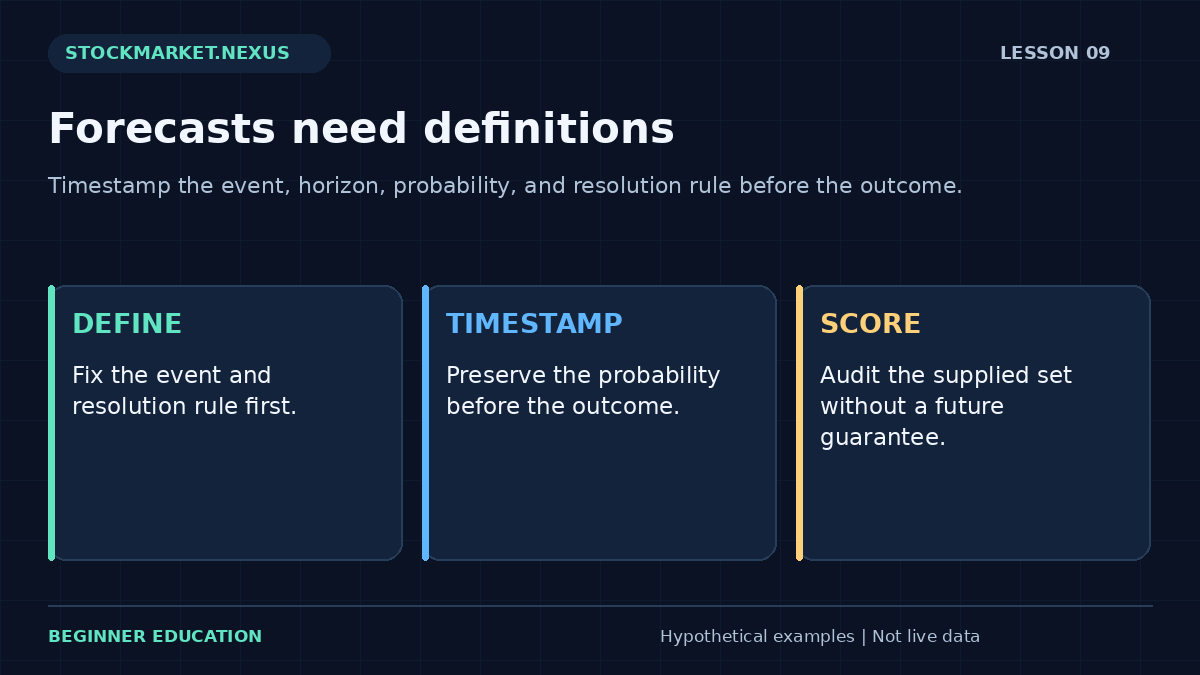
A forecast expressed as probably higher tomorrow can feel clear while hiding several definitions. Higher than which price, at what time, under which session, and how will a missing observation be resolved? Probability thinking begins with a well-defined event and a record made before the outcome.
This lesson introduces an educational Brier-score worksheet for fictional binary forecasts. It measures the squared difference between a supplied probability and a resolved zero-or-one outcome. The score is a descriptive audit of the entered set, not proof of a trading edge, a psychological assessment, or a guarantee that a forecast is calibrated.
1. Define the event before assigning a probability
An event should specify the instrument or scenario, observation horizon, reference, and resolution rule. “The next completed regular-session close exceeds today’s completed close” is more testable than “the chart will work.” Equal closes, missing data, and changed sessions need explicit treatment.
Timestamp the probability before resolution. A forecast edited after the outcome is not the same forecast. Preserve the original even if later information produces a revised estimate, and label the new information time separately.
The worksheet assumes binary outcomes have already been resolved consistently. It cannot verify timestamps or decide whether a real market event met the definition. Those responsibilities remain in the surrounding journal.
2. Separate probability from confidence in the data
A 70% probability is a statement about the defined event under a model or judgment. It is different from confidence that the input data is accurate or that the method has been validated. A learner can be uncertain about both, and a single number should not hide those layers.
Avoid assigning 100% merely because a chart looks persuasive. A probability of one receives a large error when the event fails, just as a probability of zero does when it occurs. The exercise accepts endpoints to teach the scoring arithmetic, not to encourage certainty about markets.
The evidence-review lesson helps identify what supports an estimate and which information remains unresolved. A precise probability does not upgrade weak evidence into strong evidence.
3. Calculate the Brier contribution
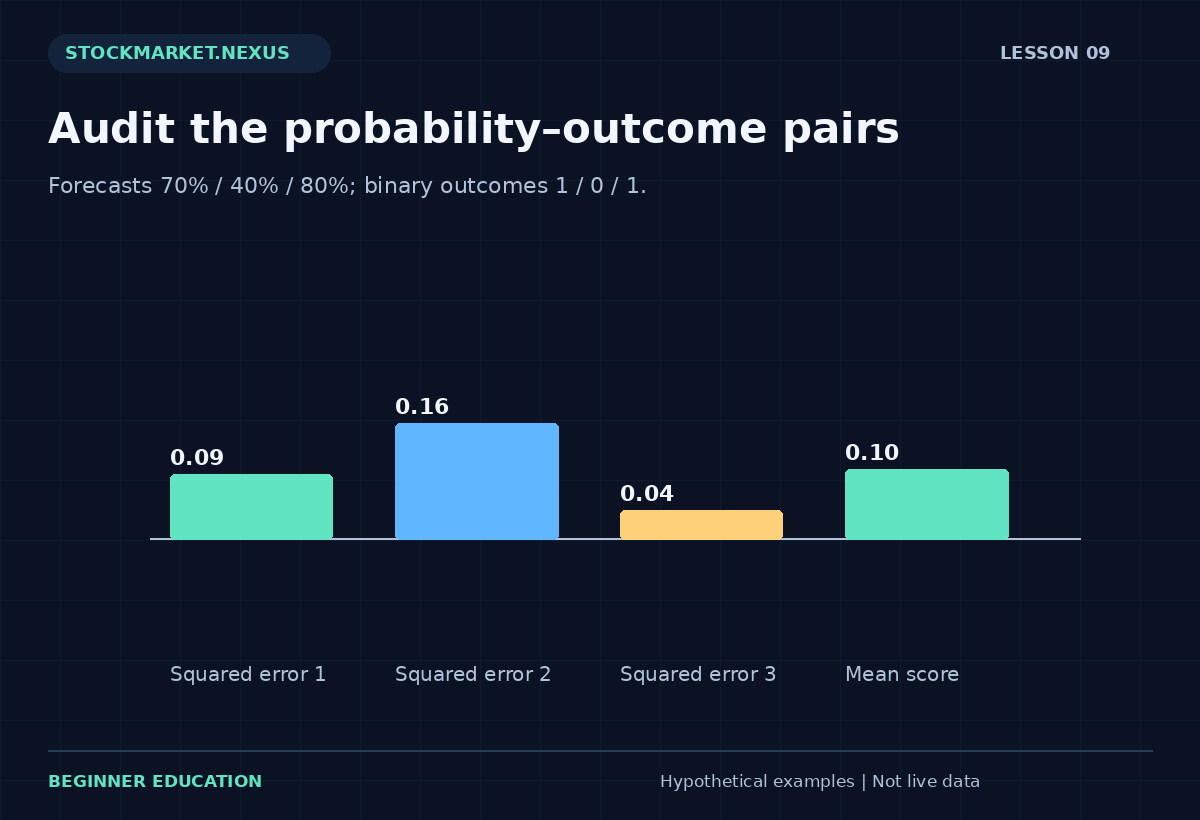
For one binary forecast, convert percentage probability to a fraction p and calculate p minus outcome, squared. A 70% forecast with outcome one contributes (0.7 − 1) squared, or 0.09. The same forecast with outcome zero contributes 0.49.
Average the contributions across the supplied observations. For probabilities 70%, 40%, 80% and outcomes 1, 0, 1, the contributions are 0.09, 0.16, 0.04. Their mean is approximately 0.0967. Lower is better for this defined scoring calculation on the entered sample.
The score ranges from zero to one for valid binary probabilities and outcomes. It is not a percentage of profitable trades. It also does not include transaction costs, payoff sizes, quantity, or account return.
4. Understand what a score does not establish
A low score in a small selected sample can arise without reliable future forecasting skill. The event population, selection, dependence, and probability-editing process all matter. A worksheet cannot establish out-of-sample calibration from a few examples.
Calibration concerns whether stated probabilities correspond to observed frequencies across suitable groups of forecasts. A single average score also reflects other properties, including how forecasts distinguish events. It should not be presented as a complete calibration diagnosis.
A strategy can have useful probability estimates and still have unattractive economics if costs and payoff sizes are unfavorable. The expectancy lesson separates those financial assumptions from event probability.
5. Use a comparison carefully
A baseline forecast can provide context, but it must be chosen and evaluated consistently. The exercise shows a simple constant-50% comparison for the same supplied outcomes. Its contribution is always 0.25 for a resolved binary event.
Beating that baseline in the entered sample does not prove superiority to a more appropriate historical or model baseline. Event frequency can be very different from half. A complete forecasting study should select the reference method before evaluating the held-out sample.
The tool avoids a performance badge or readiness threshold. It reports the arithmetic and asks which sample and baseline definitions would be needed for a stronger conclusion. That restraint is part of professional probability language.
6. Use the dedicated forecast audit
Open the Lesson 9 probability exercise. Enter probabilities 70, 40, 80 and outcomes 1, 0, 1. Predict the three squared errors and mean near 0.0967 before calculating. Compare with the constant-half reference of 0.25.
Change the first outcome to zero while keeping its original probability. The first contribution becomes 0.49 and the average worsens. Do not edit the earlier probability to make the score look better; that would change the forecast record after resolution.
The lists must align, probabilities must lie between zero and 100, and outcomes must be exactly zero or one. An unresolved event should remain outside the resolved score with its status recorded separately, not be forced into a favorable outcome.
7. Practice forecasts without turning them into orders
A paper forecast can be studied without a trade. Keeping that distinction allows the learner to examine language, definitions, and scoring without assuming every opinion deserves financial exposure. A forecast record is not an instruction to enter a position.
The small-sample lesson explains why a recent favorable set should not automatically expand claims or quantity. Probability practice is useful when it improves the record, not when it creates a new source of false certainty.
Include all eligible forecasts under the predefined rule, including ordinary and unfavorable ones. Preserve revisions and missing resolutions. A selected collection of impressive predictions lacks the denominator needed to evaluate the method honestly.
8. Case review: the event definition changed afterward
A learner forecasts a higher close, but price rises intraday and finishes lower. The review then changes success to any intraday rise. That new event may be worth studying, but it is not the original forecast’s resolution rule.
A professional record scores the original event as defined and creates a separate version for the revised question. It also identifies what information was available at each probability timestamp. The aim is an auditable experiment rather than a winning narrative.
For practice, write the event, horizon, equality convention, missing-data rule, and probability time before entering numbers. Then score only the consistently resolved set. Clear definitions make probability thinking useful even when the result is disappointing, because the learner can identify exactly what was forecast and what remains unsupported.
Extended case: a correct forecast can still be a poor record
A learner writes an 80% probability but does not define the reference or horizon. Price later rises, and the forecast is declared successful. Without a resolution rule, the journal cannot establish which event was predicted. A favorable later movement does not repair the missing definition.
A revised paper study defines the next completed close relative to the previous close, specifies equality and missing-data handling, and timestamps the probability. Those changes make scoring possible, not necessarily accurate forecasting. The event definition and the probability estimate remain separate parts of the method.
Use probabilities 70, 40, 80 with outcomes 1, 0, 1. The mean squared error is about 0.0967. Now change the first outcome to zero and preserve the original probability. The mean becomes 0.23. The changed result is an audit consequence, not a reason to edit the earlier forecast.
Compare with the constant-50% reference of 0.25 while noting its limitation. A study of rare events would need a more relevant preselected baseline. Beating a simple reference in three fictional cases does not establish calibrated probabilities, independent skill, or profitable execution.
Before finishing, explain the difference between a score for the entered set and a claim about future performance. A good study needs eligible forecasts, preserved timestamps, consistent resolution, and an appropriate independent evaluation. A trading strategy additionally needs payoff sizes, costs, and exposure. Probability language becomes more professional when it narrows the claim to what the record supports rather than making uncertainty sound precise enough to disappear.
A repeatable practice protocol: record, rehearse, and review
Begin with one fictional situation and write the question before using the exercise. Identify the original rule, the information available at the decision time, and the observable action being studied. Keep those fields separate from the later result. If the original rule is missing, label the process state unknown rather than reconstructing a favorable story from the outcome. An honest incomplete record is more useful than a confident classification that cannot be checked.
Use the exercise as a structured rehearsal, not an assessment of personality or financial readiness. The tools in this course organize text, compare entered scenarios, or summarize supplied observations. They do not diagnose a condition, measure emotional fitness, verify a source, or certify a trading method. A completed checklist or a well-formatted response card can still rest on incomplete information. State what the tool actually establishes and which judgments remain outside its scope.
Predict the effect of one controlled change before calculating or generating the next record. Change one field at a time, then explain whether the change affected a financial assumption, a process classification, a denominator, or the completeness of the written plan. Avoid changing several assumptions until an attractive result appears. The objective is understanding the relationship among inputs, not obtaining approval from a screen. A result that exposes an inconsistency can be a successful learning outcome.
For text exercises, review the output for specificity rather than assuming that any completed sentence is a good plan. Can the cue be recognized before the outcome? Is the response an observable action within the learner’s control? Does the review boundary identify the next information checkpoint while preserving the option of no new proposal? The form can check for missing fields, but it cannot know whether a statement is truthful, relevant, or operationally sufficient. That review belongs to the learner’s process.
Keep confirmed account state separate from intention. A submitted instruction is not a completed fill, and a cancellation request is not necessarily a confirmed cancellation. A pause, closed browser, or reflection exercise does not remove an existing holding. In a paper scenario, state the assumed execution and quantity. In a completed transaction record, reconcile actual fills and charges. Psychology practice should make those responsibilities clearer rather than covering them with reassuring language about control or calmness.
After the rehearsal, write four short observations: what triggered the situation, what action occurred, how it compared with the original rule, and what remained unresolved. Add the financial result separately when one exists. A profitable deviation remains a deviation under the original definition; a compliant loss remains compliant. Neither classification proves the rule itself is sound. A later research review can evaluate the method without rewriting the earlier behavioral record.
Preserve the first version and add dated revisions. If a cue was too vague, a response too long, or a required source unavailable, identify that specific obstacle. Change one part of the practice design and define a new observation period. Repeatedly replacing the entire routine after a short unfavorable run makes it difficult to learn which change mattered. Do not promise that a fixed number of repetitions will create a permanent habit or profitable behavior. Measure the selected task and the quality of its output instead.
Finish by explaining the exercise to another beginner without using an identity label or a performance promise. State the units, assumptions, and limits of any calculation. State which observations would support a different interpretation. Include missed, ordinary, and unfavorable examples in the broader record rather than saving only persuasive cases. The strongest result of this course is a more accurate, auditable learning process: clearer questions, observable responses, honest exceptions, and a documented reason when a proposal remains unresolved. Those habits support better review while leaving market uncertainty and personal circumstances visible.
Additional audit checkpoint
Keep the probability convention visible when comparing software. This exercise uses the mean squared error for the event probability and its binary outcome on a zero-to-one scale. Some multi-category presentations use a different summation convention. A numerical difference should prompt a definition check before a claim that one tool is wrong. Neither convention supplies the missing timestamp or event definition. Accurate scoring begins with comparable inputs and a preserved original forecast, not the appearance of precision in the final decimal.
Sources and exercise scope
Primary background reference provides additional context. The fictional cases, diagrams, and practice procedures are original educational illustrations. General behavioral research is not proof of a trading-profit effect. Worksheets do not diagnose, assess personal suitability, or certify readiness; numerical outputs depend on the stated conventions.