


Options Trading · Lesson 10 of 15 · Reviewed November 10, 2026
A covered call combines owned stock with a short call on the specified deliverable. The premium received can offset part of the stock's downside in the modeled economics, but it does not remove that downside. In exchange, the call can limit participation above the strike and can require delivery of the shares if assigned.
This lesson uses 100 fictional shares bought at $50 and one standard $55 call sold for $2 per share. The expiration model ignores dividends and charges until they are added explicitly. It is a study of a combined position, not a recommendation to sell calls on a particular holding.
1. Identify both components before interpreting income
The account owns 100 shares and owes performance under one short call. The $200 premium receipt is not the entire position's value or maximum risk. The stock purchase required $5,000 before charges. If the stock falls sharply, the premium offsets only a limited amount of that decline.
The call's deliverable must match the shares intended to cover it. Adjusted contracts, unequal quantities, or a different underlying can invalidate a simple coverage assumption. Verify the actual terms rather than relying on a strategy label displayed by an interface.
The contract foundation lesson explains the writer's obligation. Covered describes a particular relationship to the deliverable; it does not mean that every economic outcome is protected or that the shares cannot be called away.
2. Calculate the combined expiration result
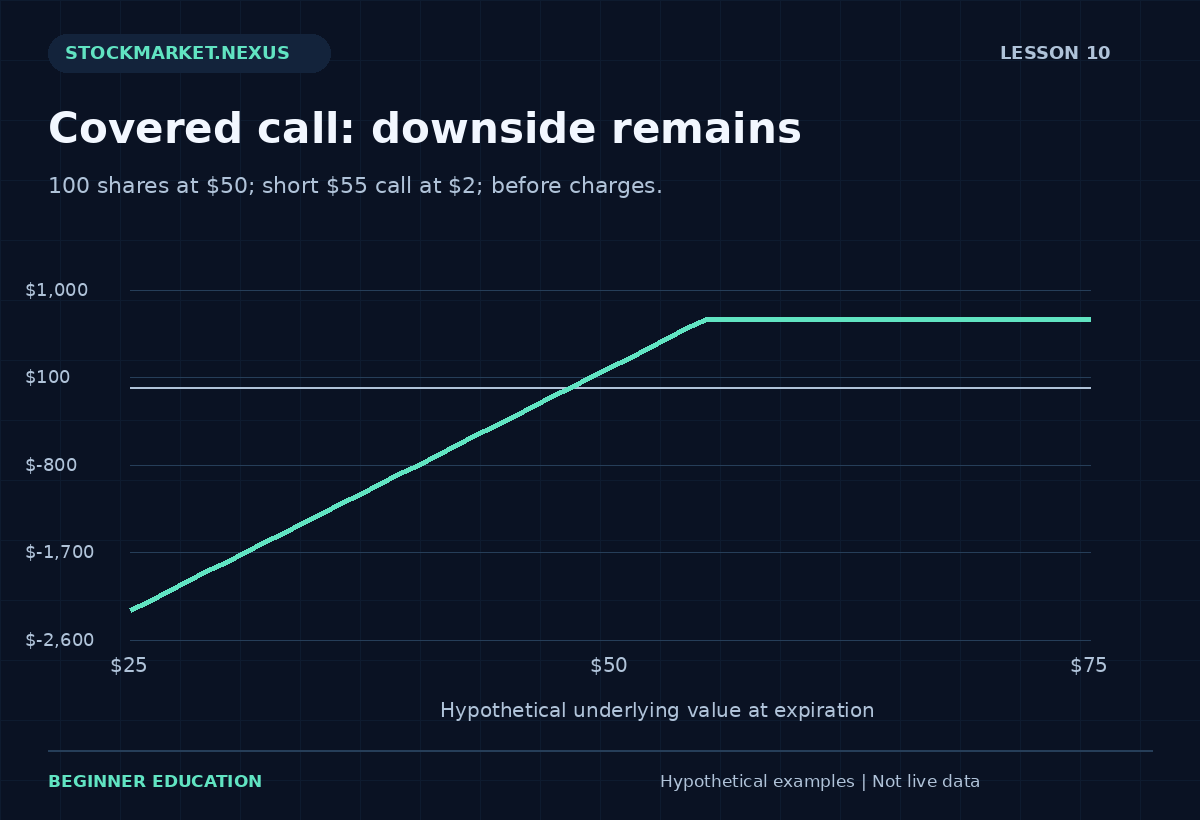
For the standard simplified model, the stock's effective terminal sale value is capped at the call strike when considering the intact covered-call economics. At an underlying expiration value below $55, the call has no positive intrinsic obligation in the payoff arithmetic. Above $55, the short call offsets further stock appreciation.
At $40, the stock loses $1,000 relative to its $50 entry and the premium contributes $200, producing minus $800 before charges. At $50, the combined result is plus $200. At $60, the modeled combined gain is $700: five dollars of stock appreciation plus two dollars premium per share.
Maximum modeled gain is $700 before charges. The simplified breakeven is $48. If the stock becomes worthless, the combined price-and-premium loss is $4,800 before charges. A premium described as income therefore coexists with substantial underlying downside.
3. Understand the opportunity cost above strike
If the stock rises far above $55, the covered-call position does not participate in all the stock's additional gain under the expiration model. The writer accepted that cap when taking the premium. It should not be treated as an unexpected defect discovered only after the rally.
Compare the combined result with the same stock holding without the call over the same dates and using consistent charges and distributions. The call can improve one range of outcomes while reducing another. Selecting only flat-market examples gives an incomplete picture of the tradeoff.
The protective-put lesson illustrates a different combined structure that pays premium for a modeled downside floor. The two strategies have different cash flows and objectives; neither should be chosen solely because one premium arrives and the other leaves.
4. Include assignment and dividend-related considerations
A short American-style call can be assigned before expiration. Dividend-related incentives can matter, but the writer cannot rely on certainty about another holder's exercise choice. Verify the event calendar and the broker's assignment procedures. The shares may be delivered sooner than the preferred holding deadline.
An investor who is unwilling or unable to sell the shares at the strike has a mandate conflict that premium alone does not resolve. Taxes, holding restrictions, and other account-specific consequences can also matter, but they require appropriate account-specific information rather than assumptions from a generic example.
The exercise and assignment lesson explains the share transition. The covered-call review should identify both the current stock quantity and the active short-call quantity after every fill or assignment notice.
5. Treat buying back or rolling as a new transaction
Buying to close the short call can cost more than the premium originally received. The transaction changes the call component's realized result and leaves the stock exposure unless separately sold. A closing order must actually fill before the obligation is considered removed.
A roll closes one contract and opens another. It can extend time, change strike, create a new premium flow, and preserve ongoing stock risk. A net credit on the combined ticket does not erase a realized loss on the old call or guarantee that the new position improves the final outcome.
The journal should preserve both transactions and the full stock history. Reporting only cumulative credits can conceal the cost of closing contracts and the underlying's changing value. Combined-position accounting is essential to evaluating what the method actually produced.
6. Practice the capped payoff and the retained downside
Use the covered-call practice exercise to enter stock basis, strike, received premium, quantity, and a hypothetical expiration stock value. The output should include total result, capped gain, downside at zero, and breakeven under the simplified assumptions.
Compare $40, $50, and $60 outcomes for the example. Then raise the terminal value to $80 and observe that the modeled covered-call gain remains capped. This demonstrates the accepted tradeoff without implying that assignment will always occur in an identical mechanical way in a real account.
Finally, write whether delivery of the stock at strike is acceptable under the fictional mandate. A correct payoff calculation is insufficient if the intended holding cannot be sold. The exercise should connect economic geometry with the actual obligation the short call creates.
## Worked covered-call comparison with stock alone
Use 100 shares entered at $50 and one $55 call sold at $2. At terminal stock values of $40, $50, $55, and $70, the simplified covered-call results before charges are minus $800, plus $200, plus $700, and plus $700. Stock alone would produce minus $1,000, zero, plus $500, and plus $2,000 over the same price references.
The call improves some outcomes by the received premium but gives up participation beyond the cap. The $70 row is important because it makes the accepted opportunity cost visible. The method should not be evaluated only on quiet periods where the premium looks like an uncomplicated addition.
Add charges consistently to both alternatives. If one comparison includes distributions or a different stock holding window, label that difference rather than presenting the results as directly equivalent. A fair comparison begins with matching dates, quantity, and valuation conventions.
Separate a current holding's basis from a new decision
Shares already owned can have a historical basis different from the current quote. A covered-call calculation using that basis describes one accounting perspective, while the decision to retain the shares from today's value raises another economic question. State which reference the worksheet uses.
A large unrealized gain does not make the shares free or remove their downside from the current market value. Likewise, a low historical basis does not determine whether delivering the shares at a chosen strike fits the current mandate. The short-call decision should be evaluated with the actual intended holding and account consequences.
For an educational exercise, use a clearly supplied basis and avoid making tax conclusions. The goal is to reconstruct the combined payoff consistently. Account-specific tax or restriction effects require additional information and should not be inferred from a generic premium calculator.
Audit a buyback and a roll
Suppose the call was sold for $2 and later bought back at $4. The option component realizes a $200 loss per standard contract before charges. If the stock rose during that period, the combined position may have another result, but the call loss should remain visible rather than be erased from the record.
Opening a replacement call at $4.50 after the $4 buyback produces a fifty-cent net premium receipt across those two transactions. It does not mean the original call never lost money. The replacement contract has new terms, time exposure, and an assignment obligation that need their own review.
A journal should retain the original stock holding, each call's opening and closing fills, and the current short quantity. Reporting only the latest roll credit can conceal the path. A professional record shows both realized history and continuing exposure without using the cash-flow sign as proof of improvement.
Test whether delivery is acceptable before opening
Write the exact shares that would be delivered if the call were assigned and the strike proceeds involved. If the mandate requires retaining those shares under all circumstances, selling the call creates a conflict that the premium does not resolve. The exercise should make that conflict visible before the obligation exists.
Also verify whether the position remains covered after a partial stock sale or another account action. Selling some shares without adjusting the short-call quantity can change the structure. A strategy label retained by a spreadsheet does not guarantee that the actual deliverable relationship still holds.
The final review should answer three separate questions: what the combined expiration model shows, what the writer is obligated to deliver, and what the account actually holds now. Keeping those questions separate gives beginners a realistic understanding of covered calls beyond an appealing premium-income headline.
## How to complete and review the lesson exercise
Start by writing the contract identity and the calculation's time horizon before entering numbers. A quoted premium, a hypothetical expiration value, and a strike-related cash transaction are different inputs. State which one the exercise uses. This prevents a correct arithmetic operation from answering the wrong question. The worksheet should support the lesson's definitions rather than encourage the visitor to infer a real trade from an attractive output.
Next, translate every per-share figure into the stated contract units. Use the actual multiplier and deliverable when studying a real specification; the lesson exercises intentionally use clearly labeled standard examples. Keep quantity separate from price. Increasing contract count changes total dollars and obligations without improving the underlying hypothesis. A small premium displayed on a chain can therefore become a material aggregate amount when multiplied across several contracts.
Use three input checks before interpreting the result. First, confirm that the option type and position direction match the intended lesson. Second, confirm that the premium, strikes, and quantity are internally coherent under the exercise's model. Third, distinguish a supplied scenario from an estimated probability. A table of possible outcomes does not assign odds to its rows, and a local sensitivity calculation does not forecast which input change will occur.
Record charges under one consistent convention. If actual entry and closing premiums already reflect the bid and ask, do not subtract the same spread again as an additional explicit fee. If the exercise begins with reference prices instead, label any separate friction assumption. The distinction is especially important when comparing several examples: a strategy should not receive favorable midpoint fills while an alternative is evaluated with less favorable executable quotes.
After calculating, describe the account state in plain language. State whether the model refers to an owned option, a short obligation, a matched combination, a completed premium transaction, or a possible underlying purchase or delivery. A numerical result is incomplete if the learner cannot identify what remains held or owed. Exercise and assignment can create a different position from the one shown on the original option payoff chart.
Repeat the exercise with one adverse change and one favorable change while keeping the other supplied inputs fixed. This is a controlled comparison for learning mechanics, not evidence of a real-market distribution. Preserve both results. Do not remove an unfavorable example because it makes the strategy less appealing, or reinterpret the original terms after seeing which alternative would have performed better.
Finally, separate the model's conclusion from the facts it does not establish. A simplified expiration calculation can explain economic geometry without reproducing early exercise, broker liquidation, unavailable execution, taxes, dividends, financing, or every temporary account state. A Greek worksheet can teach units without implementing a complete pricing model. The relevant omissions are specific limitations of the exercise, not reasons to ignore the calculation or to treat it as more complete than it is.
A useful review contains the original inputs, the formula or rule applied, the contract-dollar result, the remaining account-state question, and one correction if an error occurred. Keep process compliance separate from whether the chosen scenario was profitable. The objective is a reproducible explanation that another reader can audit. Repeating a known example can improve fluency, but it does not certify real-money readiness or establish future returns.
## Sources and further reading
Primary educational reference provides background. Review the OCC options disclosure document for standardized-option characteristics and risks. Numerical examples and worksheets in this lesson are fictional educational illustrations.