

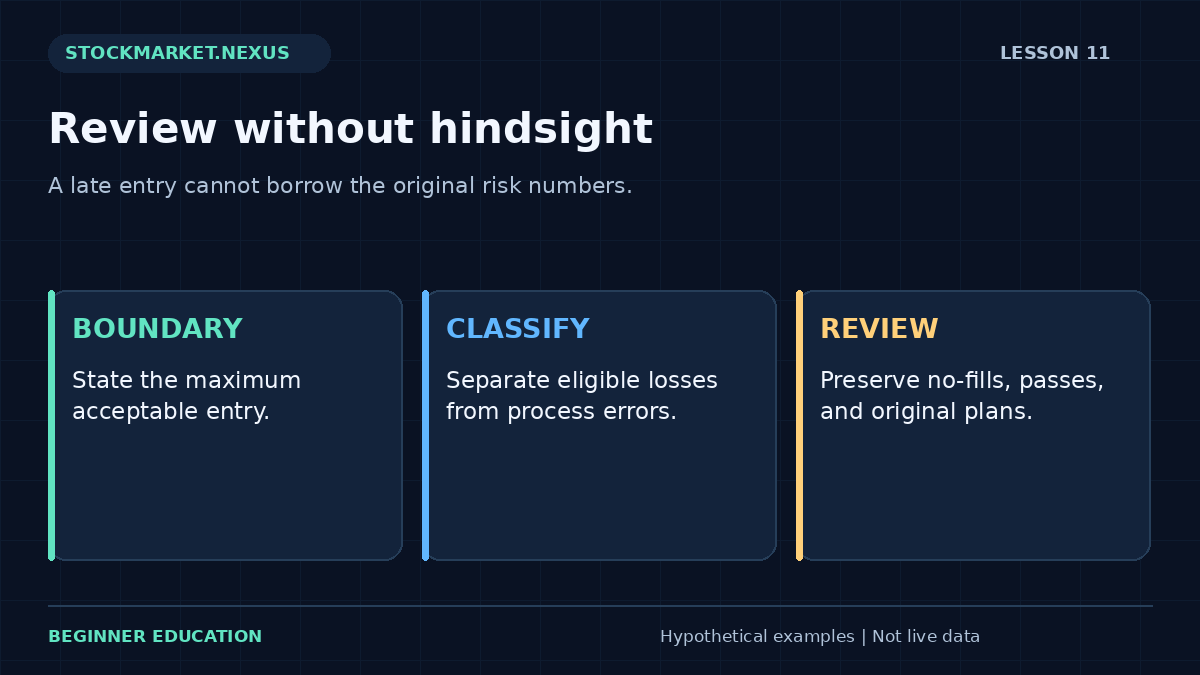
Day Trading · Lesson 11 of 15 · Reviewed November 9, 2026
A price moves above a visible level and accelerates. The trader hesitates, then enters after the move has already expanded. Moments later, price returns below the reference. The experience can feel as though the market deliberately waited for the entry. A more useful review asks what the original method required, what information was available, and how the delayed decision changed exposure.
This lesson uses fictional long-stock examples to distinguish a failed setup from an unplanned chase. It does not offer a way to identify every reversal in advance. The objective is a decision process that can recognize uncertainty, reject unsuitable entries, and learn from outcomes without inventing a perfect historical explanation.
1. Define the reference before calling the move false
A breakout is meaningful only relative to a specified level and condition. The level might be a completed opening high, a prior-session reference, or another rule-defined area. A brief transaction above it, a completed close beyond it, and a successful retest are different observations.
Likewise, failure needs a definition. Returning inside a range for one quote differs from closing inside it or moving through a separate invalidation level. If the definition changes whenever the result is uncomfortable, the method cannot be evaluated consistently. Preserve the original condition and timestamp.
The opening-range lesson demonstrates how to specify the reference and when it becomes available. A final chart can make a failure seem obvious. At the decision time, the later reversal did not yet exist. The review must respect that information boundary.
2. Separate an eligible loss from a process error
A trade can meet its written conditions and still lose. That outcome does not automatically show that the trader lacked discipline or that the setup was fraudulent. A method is a hypothesis under uncertainty. Its failure cases belong in the evaluation.
A process error is different: entering before required confirmation, exceeding quantity, ignoring a price boundary, or trading outside the defined session. A favorable outcome does not erase that deviation. If wins excuse broken rules while losses are blamed on the market, the record teaches the wrong behavior.
Use two review columns: outcome and adherence. Write what happened financially, then whether the decision matched the method. This distinction makes it possible to improve execution separately from assessing the strategy's evidence. It also reduces the temptation to rewrite every losing trade as something that should have been obvious to avoid.
3. Recognize what chasing changes
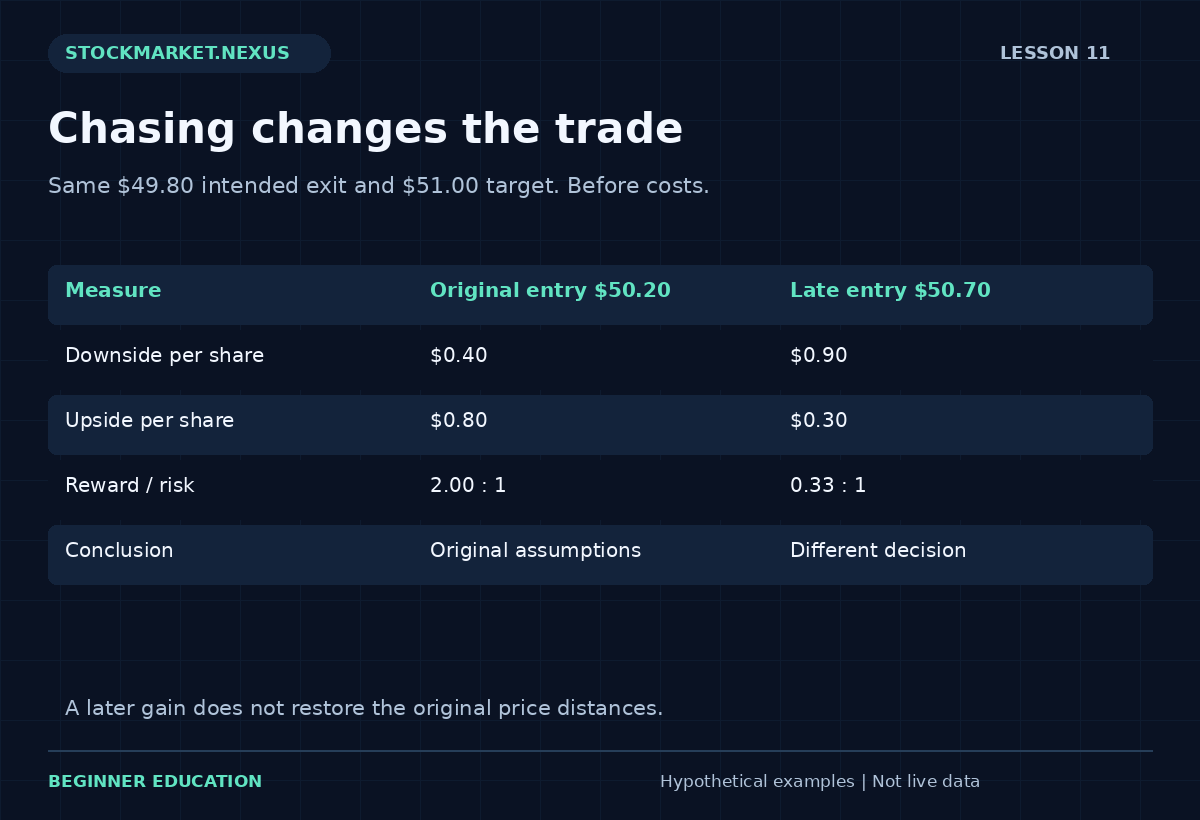
Chasing usually involves reacting to a move after the original entry conditions or acceptable price have changed. It can widen the distance to invalidation, reduce remaining target distance, increase cash commitment, or introduce a new context. The stock may be the same, but the trade is no longer identical.
Suppose a plan uses $50.20 entry, $49.80 intended exit, and $51.00 target. Planned downside is forty cents and upside eighty cents. Entering instead at $50.70 with the same exit and target creates ninety cents of downside and thirty cents of upside before costs. The attractive original ratio has disappeared.
The correct response is not necessarily to select a closer stop just to restore the ratio. That changes the invalidation assumption. Reassess the complete plan or pass under a written rule. A later continuation does not retroactively establish that ignoring the changed exposure was appropriate.
4. Write a maximum acceptable entry condition
A price boundary can define when the original opportunity has moved beyond the method's scope. It may be expressed through a limit instruction, a maximum distance, a time expiration, or another observable rule. The choice needs evidence and should be established before the session.
A limit order can constrain execution price but remain unfilled. If it misses the move, record a no-fill. Do not count the later price path as an unrealized gain the account somehow earned. Missing a trade is a different outcome from losing money on an executed position.
The intraday exit guide explains the corresponding exit tradeoffs. Entry and exit rules must agree. A narrow entry boundary combined with an improvised, expanding exit does not preserve the original risk plan merely because one side of the trade was controlled.
5. Understand the role of urgency
Urgency can arise from a fast quote, a social-media alert, another trader's screenshot, or the memory of a previous missed winner. Those experiences can make the next move feel scarce and personally important. They do not establish that the current price meets the method's criteria.
A short decision checklist can create a useful interruption: instrument, current quote, required condition, quantity, intended exit, event context, and reason to pass. If there is no time to answer those questions, the setup may exceed the learner's current operational readiness. Speed should follow practiced comprehension.
Do not turn the checklist into a ritual that always approves the trade. It should be able to say that the opportunity has passed, the data are unclear, or attention is insufficient. A boundary that survives the discomfort of a missed move has more practical value than one rewritten whenever the chart becomes exciting.
6. Treat volume as evidence to interpret, not certainty
A surge in activity can accompany a move beyond a level, but it does not guarantee continuation. Every completed trade has both sides. The meaning depends on timing, the comparison period, liquidity, and the rule being studied. A completed bar's final volume cannot be used for an earlier decision without introducing future information.
A high-volume reversal is also possible. Do not invent a confident explanation about all participants' intentions from the chart alone. Separate confirmed observations from interpretations. “Activity increased during this interval” is narrower and more defensible than a claim that every large buyer has committed to the trend.
The intraday-liquidity guide connects activity with actual execution conditions. A move can be highly visible while the spread or available size makes the proposed entry impractical. A descriptive confirmation should not override the funding and exposure checks.
7. Compare two fictional decisions
Maya's written method requires a completed condition above a known range and an acceptable entry no higher than $50.30. The quote reaches $50.25 while all conditions fit. She enters the practice position with a predefined quantity and exit. Price later returns inside the range and the modeled exit loses money. This can be an eligible strategy loss.
In another session, the condition appears but the price has already reached $50.80 before Maya acts. She ignores the boundary, keeps the original quantity, and enters because the move feels too strong to miss. The later reversal produces a larger loss. That record includes a process deviation in addition to the outcome.
The two cases should not be merged under a vague label such as bad breakout. The first informs strategy evaluation; the second informs execution discipline and rule practicality. Accurate classification makes the next improvement more specific and prevents a new indicator from being used to solve what was actually an order-selection problem.
8. Avoid revenge entries after failure
After a loss, a trader may re-enter quickly to recover the result or prove the original thesis correct. A second entry can be legitimate only if the method defines the conditions and the remaining account capacity permits it. The previous loss is not itself evidence that the next attempt is better.
State any re-entry policy in advance: maximum attempts, fresh conditions, quantity treatment, expiration, and daily boundary. A rule allowing another try should not become unlimited repetition. Costs and repeated small losses can accumulate even when each ticket looks manageable in isolation.
The daily-risk planning lesson explains how realized losses and open exposure affect remaining room. An appealing new setup does not erase the session's history. The decision must fit the current account state, not the balance the trader wishes to restore.
9. Preserve the original evidence
Capture the decision-time quote, chart state, timestamp, plan, and reason for entry or pass. Do not rely only on a final chart with ideal entry arrows added afterward. The completed path contains information the trader did not have, including later extremes and the eventual session classification.
If an instruction never filled, keep it separate from executed trades. If a partial quantity filled, record the actual amount and weighted price. If the entry was changed, preserve the earlier version and explain the change. These details prevent the review from quietly transforming a difficult sequence into a simple success story.
A useful learning record includes missed winners and correctly rejected losers without selectively emphasizing either. Over repeated observations, inspect whether the rules are clear, practical, and supported by net outcomes. One emotionally memorable chart is weak evidence for a broad change in method.
10. Improve one decision rule at a time
A failed example can tempt a learner to add several filters: a new indicator, a longer interval, a different candle condition, and another volume threshold. If all are changed together, the record cannot identify what helped. Repeatedly fitting the same history can also produce an apparent improvement by chance.
Choose a specific problem and a specific revision. If entries are repeatedly too late, a clearer expiration boundary may be more relevant than another confirmation. If funding is misunderstood, the solution is account education. If eligible setups lose after realistic costs, the strategy itself needs reassessment.
Reserve fresh observations for evaluation after exploratory changes. Label the rule version and retain unfavorable results. Professional review does not require the method to survive every test. It requires the conclusion to match the evidence, including the possibility that the setup should be rejected.
Decision rehearsal worksheet
Write the completed reference, the precise entry condition, maximum acceptable price, quantity calculation, invalidation, and re-entry policy. Create three fictional paths: continuation after an eligible entry, reversal after an eligible entry, and a move that escapes the entry boundary before execution.
For each path, state what the plan permits before seeing the final outcome. Calculate how a late entry would alter cash commitment, price distance, and target distance. Then identify whether any later loss would be a strategy outcome, a process deviation, or both. This classification is more useful than simply calling the trade good or bad.
Finally, write a pass statement in plain language: the original opportunity no longer fits, so no order is placed. Practice accepting that result even when the fictional price continues upward. The skill being trained is consistency under uncertainty, not the ability to participate in every favorable movement shown by hindsight.
Use a counterfactual worksheet responsibly
After a missed move, write the decision that actually occurred before imagining an alternative. For example: the entry boundary was $50.30, the available ask was $50.80, and no order was submitted. The later high of $52 does not create a completed winner. It creates a historical path that can be studied under a separate, explicitly defined late-entry hypothesis.
If you investigate that hypothesis, calculate its entry, invalidation, target, costs, and funding without borrowing the earlier plan's numbers. Then test it on a broader set of fresh observations, including late entries that reversed. Selecting only the missed winner that triggered regret creates a biased research question.
A useful review can conclude that the original pass was correct under the existing rules while also identifying a possible new hypothesis for later study. Those statements do not conflict. The first assesses adherence using information available then; the second begins a new investigation. Keeping them separate prevents hindsight from turning every emotionally memorable move into proof that the method should have permitted it.
Frequently asked questions
Can a false breakout always be identified before entry?
No. A method can define conditions and filters, but later failure remains possible. Be skeptical of explanations that make every reversal seem obvious after the fact. Evaluate a broad record with realistic execution rather than assuming the right indicator removes uncertainty.
Is a late entry always wrong?
A later entry can be a distinct setup if it has its own tested rules and current risk assessment. It should not be treated as the original trade when price, timing, and distance have changed. Define the new decision explicitly rather than using the old plan's attractive numbers.
Should a losing breakout be traded again immediately?
Only if a predefined re-entry rule, current conditions, and remaining account constraints permit it. The desire to recover a loss is not a setup. If the reason is emotional or the account state is unclear, pause and reconcile before adding exposure.
Practice and source notes
Rehearse incomplete-information decisions in the Day Trading Practice Lab. The fictional outcomes are learning examples, not validated signals. For general execution background, consult the SEC order-execution guide.