

Day Trading · Lesson 02 of 15 · Reviewed November 9, 2026
Before planning repeated intraday transactions, identify the rules that apply to the actual brokerage account. A general article, a friend's experience, and the buying-power number on a screen can describe different situations. Account type, settled funding, borrowing, security eligibility, and the broker's implementation of current requirements all matter. More frequent trading creates more opportunities to misunderstand those distinctions.
This guide addresses U.S. stock-account education and was reviewed November 9, 2026. It explains the current transition without pretending every firm applies identical controls. It does not determine an individual account's eligibility or provide a way around payment or margin obligations. Obtain the account-specific answer from the broker before relying on any planned transaction sequence.
1. Identify the account you actually have
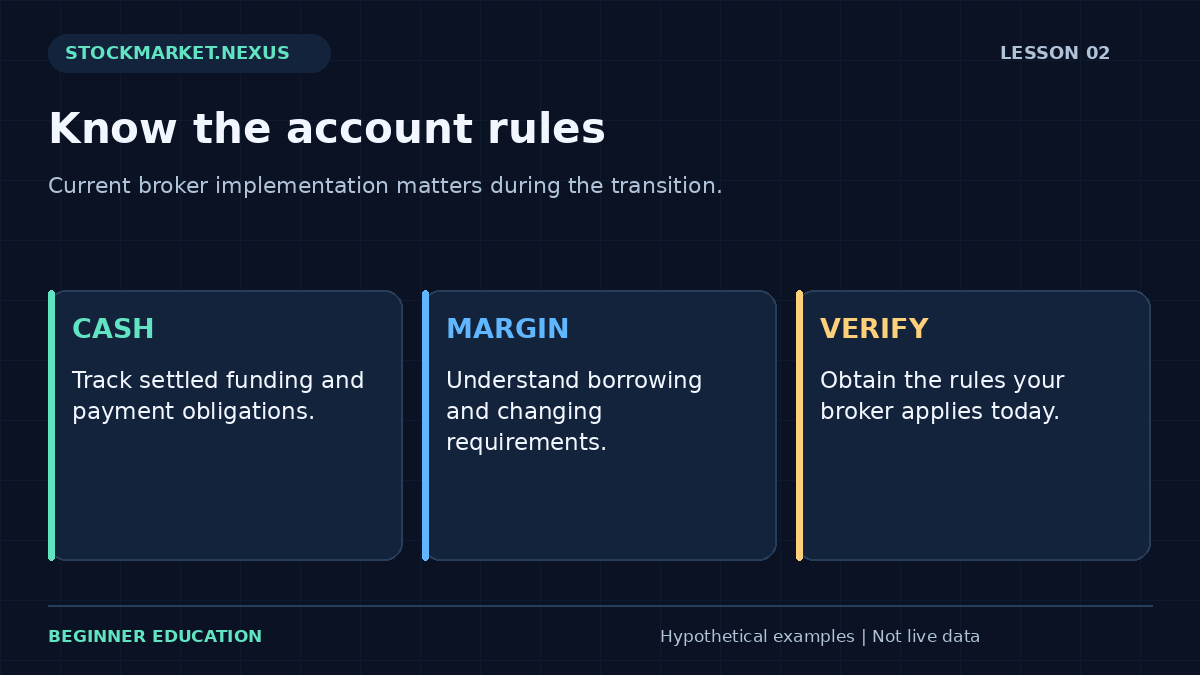
A cash account requires purchases to be fully paid without a broker loan financing them. A margin account can permit borrowing against eligible collateral under an agreement. The interface may look similar, and a margin-enabled account can also contain fully paid holdings. The account label alone does not establish whether a particular transaction creates a debit or incurs interest.
Ask whether margin is enabled, which permissions are active, and how to identify borrowing. Verify whether a recent deposit is collected and available, and whether sale proceeds are settled. A customer may see enough buying power to submit an instruction while still facing restrictions on subsequent activity. The enabled button is not a complete explanation of the agreement.
The cash-versus-margin foundation lesson explains the basic vocabulary. For intraday planning, turn that vocabulary into a ledger: opening balances, funding source for each purchase, settlement date, any debit, and remaining available capacity. A precise transaction sequence is easier for the broker to explain than a vague question about whether day trading is allowed.
2. Understand the regulatory transition
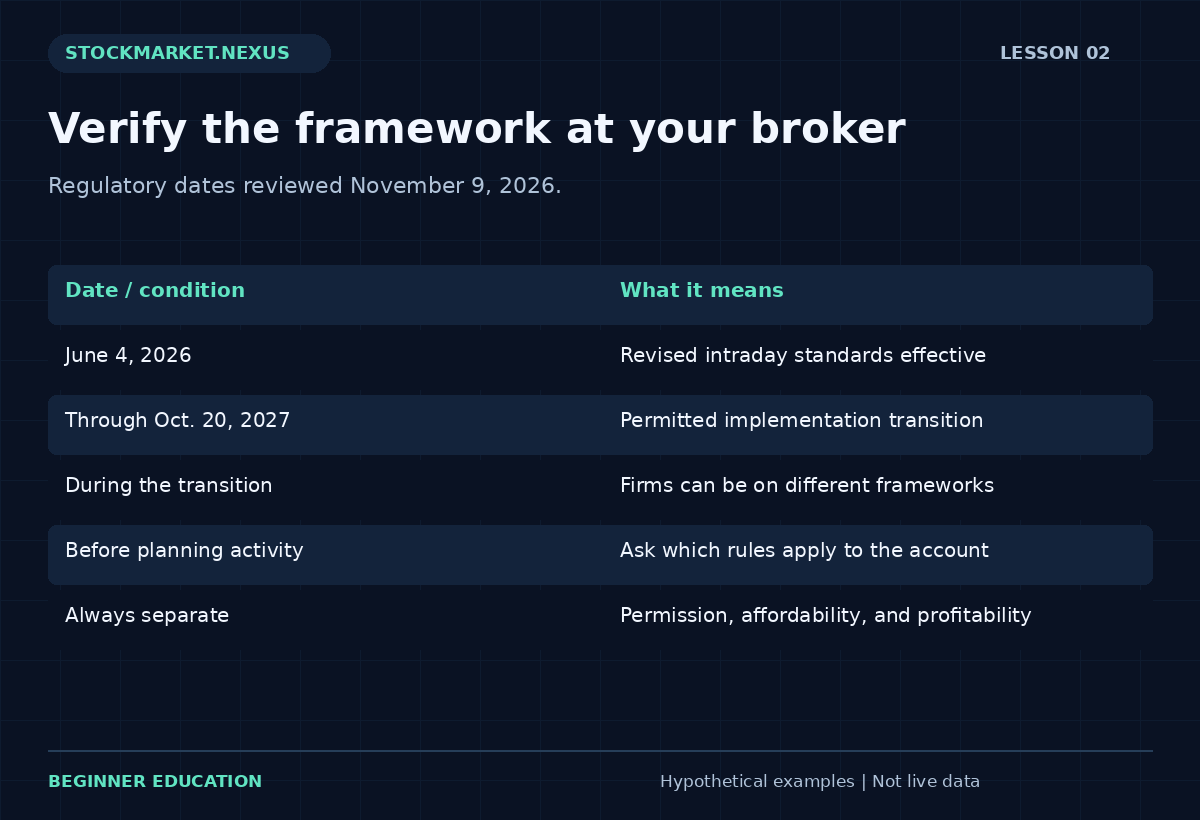
FINRA's revised intraday-margin standards became effective June 4, 2026, with a permitted implementation transition through October 20, 2027. During that period, firms may continue under the former day-trading provisions or adopt the revised framework. Consequently, a statement that the former rules have disappeared from every account is not reliable, and neither is a statement that every firm must still use them unchanged.
The former framework includes pattern-day-trader classification, trade-count provisions, and an associated minimum-equity requirement. The revised framework replaces those provisions with intraday margin standards based on exposure and equity. Replacing a classification does not eliminate borrowing risk, maintenance requirements, or broker house policies. It also does not make frequent trading suitable for every customer.
Ask which framework currently applies and when the firm expects to change it. Retain the written answer or official help-page reference with a date. Review it again when notified of a change. A regulatory transition is a reason for accurate account research, not a reason to assume that an old online shortcut now guarantees unrestricted trading access.
3. Read legacy pattern-day-trader explanations in context
At a firm still applying the former framework, pattern-day-trader rules can remain relevant. Their application depends on the defined transactions and the firm's policies. Do not calculate an account's status solely from an informal count of clicks or screenshots. Opening and closing activity, multiple executions, and the firm's treatment can require a more detailed explanation.
An old minimum-equity figure should not become a personal funding recommendation. Meeting a regulatory or broker threshold does not establish that the money is affordable to lose or that the trading process has an advantage. Likewise, being below a threshold does not justify seeking an unfamiliar account structure solely to evade a constraint.
Describe the proposed activity to the broker using dates, quantities, instruments, and account type. Ask how the firm would classify it under its current framework. If the response conflicts with a generic article, the article should not override the account agreement. Pause until the discrepancy is resolved rather than testing the rule by placing an uncertain trade.
4. What the revised intraday framework changes
The revised approach focuses on margin exposure during the trading day rather than the former pattern-day-trader label and trade-count minimum-equity structure. Firms have flexibility in implementation, including controls that can block activity creating a deficiency or calculations that lead to a margin demand. Your interface and the firm's explanation determine how those controls appear operationally.
A customer must still understand equity, eligible collateral, maintenance requirements, and any intraday deficit. House requirements can be stricter than a regulatory minimum, and some securities can receive unfavorable or changing treatment. A position acceptable in one account or on one day need not retain the same borrowing value later.
The educational conclusion is narrow: current account capacity must be verified, not inferred from the removal of an old label. A beginner should not build a strategy around the largest displayed buying-power number. That number describes a permitted capacity under assumptions and policies; it is not additional savings or a guarantee that the position can be held through every adverse move.
5. T+1 settlement remains a separate issue
For most covered U.S. securities transactions, standard settlement occurs one business day after the trade date. Execution and settlement are different events. Weekends and applicable holidays matter because one business day is not the same as twenty-four elapsed hours. Deposits and withdrawal availability can have additional broker-specific timing.
Suppose a fully paid stock position is sold Monday and normally settles Tuesday. The platform may display the proceeds Monday and may permit certain new purchases, but the funding status and subsequent sale of a replacement position still require attention. A margin-rule change does not automatically rewrite cash-account payment obligations.
Maintain a funding ledger rather than relying on memory. Record which purchase uses existing settled cash, which relies on proceeds, and when those proceeds settle. If several intraday transactions are layered together, the sequence can become difficult to reconstruct afterward. The appropriate time to understand the funding is before the next order, not after a restriction appears.
6. Compare two cash-account sequences
In the first fictional sequence, Maya begins with $1,000 of settled cash. She buys $600 of stock and sells the position later that day. The purchase was funded by money already settled. The sale creates proceeds with their own settlement timing, while the unused $400 remains a separate balance category. The same-day sale alone does not explain whether the sequence is problematic.
In the second sequence, Maya has no spare cash, sells a settled holding, and uses unsettled proceeds to buy another security. Selling that replacement before its funding is properly settled can create a payment violation under the applicable facts and rules. The important distinction is the funding chain, not whether the trade made a profit.
Terms such as good-faith violation, freeriding, and cash liquidation violation refer to different circumstances and consequences. Do not use them interchangeably or guess from a simplified example. Ask the broker to review the exact sequence, amounts, and dates. An educational ledger can help you formulate that question clearly without pretending to replace the firm's account controls.
7. Borrowing changes the account's downside
A simplified account using $5,000 of equity and a $5,000 loan to buy $10,000 of stock illustrates leverage. A ten-percent price decline reduces the position to $9,000. Subtracting the unchanged loan leaves $4,000 of equity before costs, a twenty-percent reduction in the original contribution. The loan does not fall merely because the asset does.
A larger decline can create obligations beyond the cash originally contributed. Interest, changing requirements, concentration, and forced liquidation can further affect the outcome. Do not assume a convenient warning period or the ability to choose exactly when and what the broker sells. Read the agreement's liquidation rights and shortfall provisions.
The intraday risk-planning lesson distinguishes planned trade loss from wider account exposure. A stop on one position cannot guarantee that the entire account remains within a chosen boundary. Account mechanics, trade sizing, and financial capacity must agree rather than being reviewed in isolation.
8. Build a broker-verification checklist
Ask for definitions of settled cash, cash available to trade, buying power, equity, and withdrawal availability. Confirm deposit holds, settlement treatment, supported order types, eligible sessions, and security restrictions. If margin is enabled, request the debit and interest treatment, initial and maintenance requirements, and the conditions under which collateral treatment can change.
For frequent activity, ask which intraday framework is in force, how deficits are identified, what customer action is expected, and what restrictions can follow. Ask where those conditions appear in the platform. A rule you understand conceptually can still be difficult to apply if you cannot locate the relevant balance or notification.
Keep the answer in writing when available. A dated help-page reference is easier to revisit than a remembered conversation. If the firm updates its rules, review your routine before the next session. Do not interpret silence or a lack of warnings as a promise that every future transaction is permissible.
9. Apply the rules to a daily operating plan
A daily plan should state the account type, usable funding, intended activity, and what happens when the platform rejects an instruction. An order rejection is information to investigate, not a challenge to overcome through repeated submissions or alternate controls. Confirm that no partial execution occurred before making another attempt.
The premarket-watchlist guide includes account readiness as part of preparation. The watchlist should be filtered by what the account and method can support. A security with exciting price movement can still be unsuitable because of funding, eligibility, order availability, or liquidity constraints.
End the session by reconciling positions, open instructions, balances, and expected settlement. Preserve any notices or unexplained differences. If something is unresolved, pause new activity and seek clarification. A precise operational routine reduces the chance that an accounting misunderstanding becomes a larger financial obligation.
10. Practice the ledger before trading live
Use the Day Trading Practice Lab to rehearse exposure and session decisions with fictional cash. The lab intentionally does not certify broker eligibility or reproduce every margin and settlement rule. Treat its cash limit as an educational constraint, not as evidence that a real account would permit the same sequence.
On paper, create an opening balance and three hypothetical transactions. Label the funding source for each, the expected settlement, and any remaining open position. Then explain how the sequence changes if a deposit is on hold or a sale settles after a holiday. The exercise succeeds when you can identify the questions requiring broker confirmation.
Finally, separate legal permission from personal suitability. A permitted transaction can still be unaffordable, poorly understood, or inconsistent with the account's purpose. Rules establish requirements; they do not establish profitability. A professional process respects both the formal account terms and the practical consequences of being wrong.
Frequently asked questions
Has the old pattern-day-trader framework ended at every broker?
Not necessarily during the permitted transition. Firms may implement the revised requirements at different times within the allowed period. Ask your broker which framework currently applies to the account and retain its dated written explanation. Avoid treating either an old article or a broad announcement as an account-specific ruling.
Does a cash account avoid every intraday restriction?
No. Cash accounts have payment, settlement, and broker-policy constraints. A fully funded same-day transaction and a sequence using unsettled proceeds can have different consequences. Verify the exact funding chain rather than assuming that the absence of a margin loan removes all rules.
Is buying power money I own?
Not necessarily. It can reflect borrowing capacity or other adjustments under the firm's definitions. Distinguish it from settled cash and account equity. If you cannot explain why the balances differ, resolve the question before using the larger figure to plan a purchase.
Official sources and review date
Reviewed November 9, 2026. Consult the SEC's updated pattern-day-trader explanation, FINRA's intraday-margin explanation, and SEC cash-account bulletin. Broker implementation and account terms can change; verify the current policy before acting.
Practice ledger: questions to resolve before the next session
Create four columns labeled transaction, funding source, settlement assumption, and question for the broker. Begin with an invented $1,000 settled balance. Record a $600 purchase, its later sale, and a proposed second purchase. Keep the unused original cash separate from the new sale proceeds. Do not merge them merely because the screen shows one larger total.
Now change the example so the original $1,000 is a recent deposit still subject to collection. Explain what you would need to verify before treating it as available. Then change the example again so a weekend or holiday falls between trade date and settlement. These variations demonstrate why a remembered transaction pattern is less useful than understanding the underlying balance categories.
The finished exercise should not claim that a particular sequence is approved. It should identify the account facts and the written policy needed to answer the question. Bring that precise sequence to the broker if necessary. Keep any response dated and revisit it when the firm's intraday framework or account agreement changes.