

Trading Psychology · Lesson 15 of 15 · Reviewed November 10, 2026
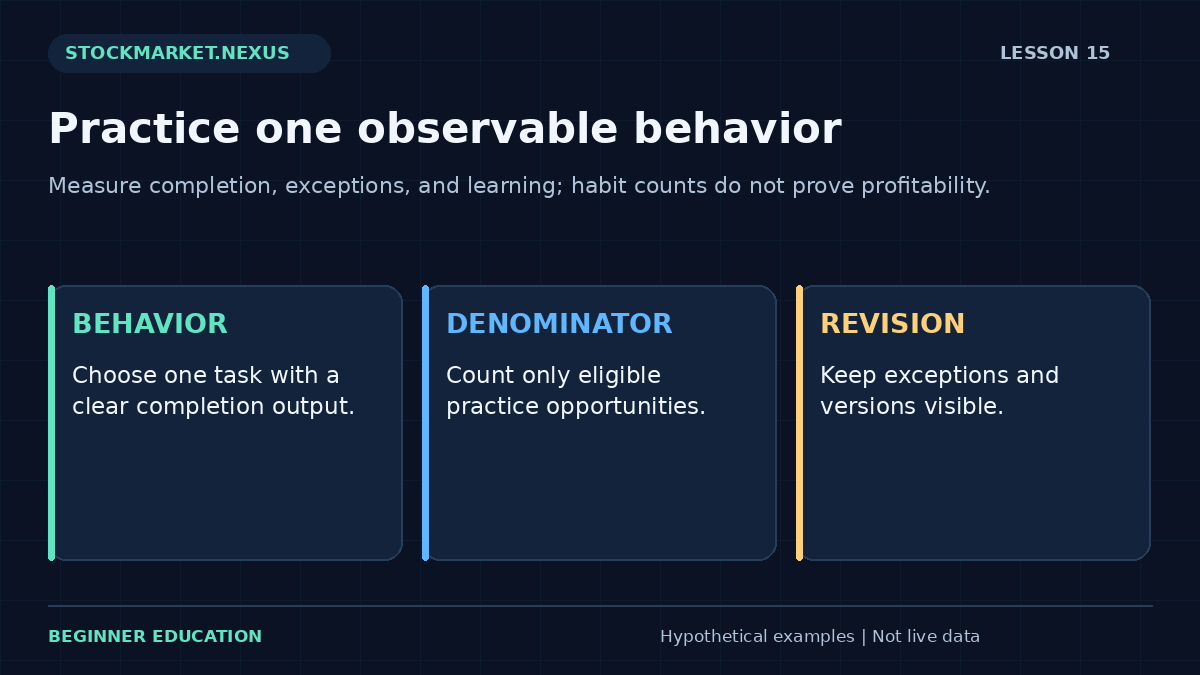
Consistency is most useful when it refers to a specific observable behavior. A learner can practice preserving the original quantity calculation, recording unknown data, or completing an end-of-session review. These tasks can be rehearsed and measured without assuming that a fixed number of repetitions guarantees a habit or profitable trading.
This final lesson builds a small practice cycle with a cue, task, completion record, exception note, and review date. The dedicated exercise summarizes a binary completion sequence and its current run. The count is a record of the selected behavior, not a psychological score, readiness certificate, or measure of a trading edge.
1. Choose one behavior narrow enough to observe
A target such as become disciplined is too broad for a completion log. A narrower target might be saving the original plan before every eligible paper example or documenting confirmed order state before reviewing a new proposal. The learner should be able to explain what counts as done.
The task should connect to an identified weakness rather than a fashionable routine. If missing cost records are the problem, practicing more chart patterns may not address it. A small relevant intervention is easier to evaluate than a complete reinvention of the workflow.
The process-journal lesson helps identify such targets from actual records. The objective is a clearer process, not an impressive streak displayed without context.
2. Define an eligible practice opportunity
A completion fraction needs a denominator. Does the task apply to every session, every paper proposal, or every completed example? A day with no eligible opportunity is different from a missed task. Decide the treatment before collecting the sequence.
The exercise assumes every supplied flag represents one eligible opportunity. One means the task met the stated completion definition; zero means it did not. Noneligible days should be recorded separately rather than automatically counted as success or failure.
A clear denominator prevents a common habit-tracking error: changing eligibility after the fact to protect a streak. The purpose is learning from the record, including interruptions, not maintaining a perfect-looking dashboard.
3. Connect the task to a cue and output
A cue can be the start of a paper session or a specific workflow transition. The output should be concrete, such as a saved calculation, a source-and-time note, or a completed review paragraph. The existence of the output makes the completion flag more auditable.
The if–then planning lesson provides a builder for this relationship. A specific plan can improve organization, but the course does not claim that general planning research establishes a trading-profit effect.
Keep the task small enough to perform under the selected practice conditions. If it repeatedly requires unavailable data or excessive time, revise the design deliberately rather than labeling every difficulty a failure of willpower.
4. Measure completion and exceptions separately
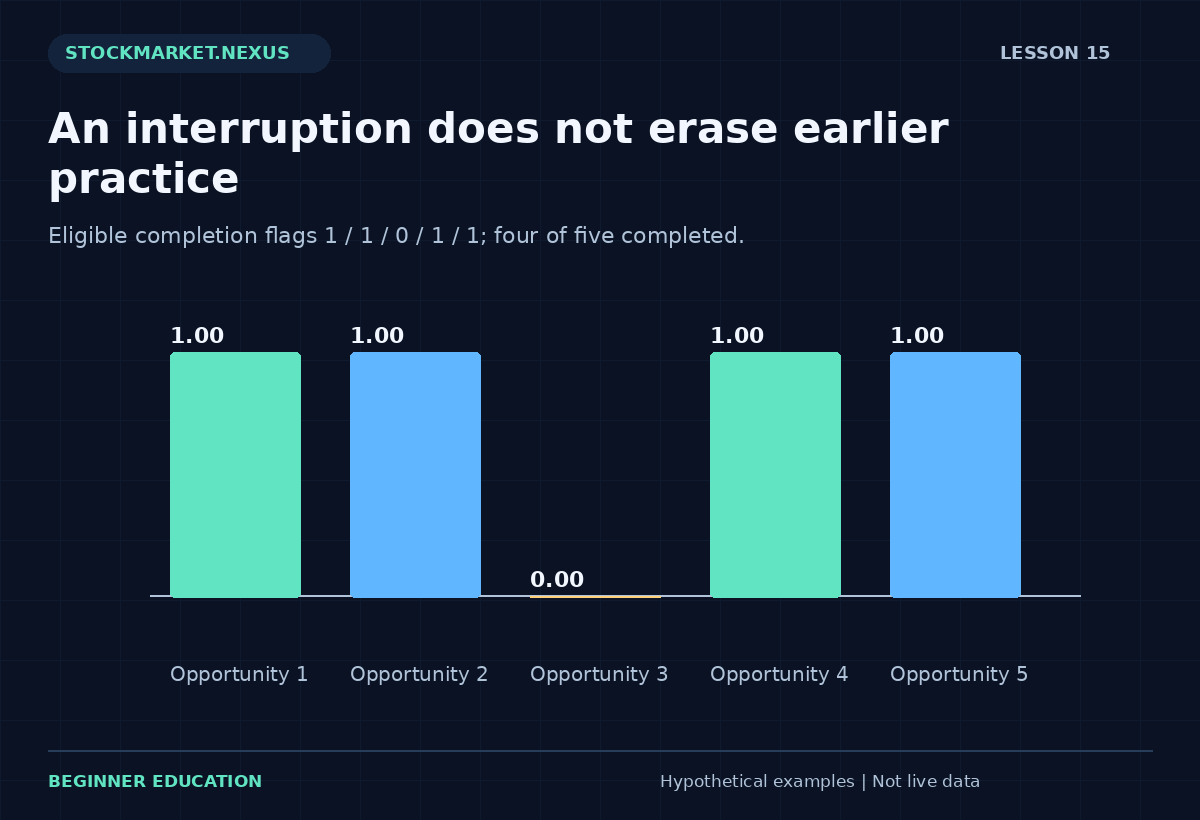
For flags 1, 1, 0, 1, 1, the completion fraction is four of five, or 80%. The current ending run is two completed opportunities. These are descriptive counts. They do not establish that the behavior will persist or that its financial consequences are favorable.
An exception note explains why a zero occurred. The cue may have been missed, the definition unclear, or the required source unavailable. Different explanations suggest different changes. The binary sequence alone cannot supply them.
A perfect record can also be uninformative if the task is trivial or incorrectly scored. Review the quality of the output, not only its existence. A saved document with no meaningful data should not automatically count as a complete analytical record.
5. Avoid universal day-count promises
There is no course rule that a behavior becomes automatic after a particular number of days. The relevant conditions include the task, opportunity frequency, environment, and definition. The worksheet should not convert a streak into a claim of permanent change.
A missed opportunity also does not erase every earlier repetition. Preserve the full sequence and investigate the interruption. Restarting the display at zero can be useful for one metric, but deleting the history removes evidence about the process.
The routine lesson helps make time and task requirements realistic. A practice plan works better as an explicit experiment than as a promise that motivation alone will overcome every constraint.
6. Use the dedicated habit-sequence exercise
Open the Lesson 15 habit-practice exercise. Enter a binary sequence for eligible opportunities and a short observable behavior label. The tool reports opportunity count, completed count, completion percentage, and ending run.
Use 1, 1, 0, 1, 1. Predict five opportunities, four completions, 80%, and a current run of two. Then append zero. The ending run becomes zero while the earlier four completions remain in the full record.
The tool rejects values other than zero or one. It cannot verify that the output met the stated definition or identify why a task was missed. Use a separate exception note and review the actual artifacts rather than treating the sequence as a complete explanation.
7. Review one change at a time
At the selected review point, inspect completion, exceptions, and output quality. Choose one adjustment with a clear reason: simplify the cue, move the journal link, reduce redundant steps, or clarify the completion definition. Preserve the earlier version.
Changing several elements at once makes it harder to understand what helped. A short favorable period afterward can also be coincidence. The appropriate conclusion is narrow: the revised workflow was easier to perform under the observed conditions, if that is what the record shows.
The small-sample lesson applies here too. A streak is useful feedback, but it should not expand claims beyond the evidence or justify automatic increases in financial exposure.
8. Case review: the streak became more important than the task
A learner wants to preserve a completion run, so a rushed empty review is marked done. The dashboard improves while the actual learning output deteriorates. The metric has displaced the behavior it was meant to support.
A revised practice definition specifies the minimum useful output and permits honest exceptions. The learner keeps the interrupted sequence instead of editing it into perfection. This produces a more trustworthy record even if the headline percentage falls.
For practice, write the behavior, eligibility rule, completion evidence, exception field, and review date before entering flags. Then explain what the numbers can and cannot establish. The professional goal is a repeatable learning routine that supports accurate decisions and honest revisions, not a streak that promises profits or defines the learner’s worth.
Extended case: the metric was completed but the behavior was not
A learner defines the task as saving a complete decision record before each eligible paper proposal. Five files are saved, so the sequence is marked 1, 1, 1, 1, 1. On review, two files lack the original quantity and required source time. If those fields were part of the prewritten completion definition, the files alone do not establish five completed tasks.
The correction should preserve the original log and explain the revised flags. The purpose is not punishment; it is restoring the metric’s relationship to the behavior. A perfect-looking streak that omits required evidence teaches less than an interrupted but accurate record.
Next use the honest sequence 1, 1, 0, 1, 1. Four of five eligible opportunities are complete, and the ending run is two. Appending a zero ends the current run but does not erase the earlier four completions or the information about why the task was missed.
For a second rehearsal, identify a noneligible day when no paper proposal occurred. The course exercise assumes every supplied flag is eligible, so record the noneligible day separately rather than automatically scoring it as success or failure. A clear denominator matters even for a simple habit tracker.
The review should inspect output quality, cue recognition, practical obstacles, and the reason for any revision. It should not promise that a certain streak creates permanent discipline or profitable trading. A useful practice plan supports one observable improvement and a trustworthy history, including ordinary interruptions. That makes the routine easier to learn from and prevents the dashboard from becoming another performance story detached from the work it was intended to measure.
A repeatable practice protocol: record, rehearse, and review
Begin with one fictional situation and write the question before using the exercise. Identify the original rule, the information available at the decision time, and the observable action being studied. Keep those fields separate from the later result. If the original rule is missing, label the process state unknown rather than reconstructing a favorable story from the outcome. An honest incomplete record is more useful than a confident classification that cannot be checked.
Use the exercise as a structured rehearsal, not an assessment of personality or financial readiness. The tools in this course organize text, compare entered scenarios, or summarize supplied observations. They do not diagnose a condition, measure emotional fitness, verify a source, or certify a trading method. A completed checklist or a well-formatted response card can still rest on incomplete information. State what the tool actually establishes and which judgments remain outside its scope.
Predict the effect of one controlled change before calculating or generating the next record. Change one field at a time, then explain whether the change affected a financial assumption, a process classification, a denominator, or the completeness of the written plan. Avoid changing several assumptions until an attractive result appears. The objective is understanding the relationship among inputs, not obtaining approval from a screen. A result that exposes an inconsistency can be a successful learning outcome.
For text exercises, review the output for specificity rather than assuming that any completed sentence is a good plan. Can the cue be recognized before the outcome? Is the response an observable action within the learner’s control? Does the review boundary identify the next information checkpoint while preserving the option of no new proposal? The form can check for missing fields, but it cannot know whether a statement is truthful, relevant, or operationally sufficient. That review belongs to the learner’s process.
Keep confirmed account state separate from intention. A submitted instruction is not a completed fill, and a cancellation request is not necessarily a confirmed cancellation. A pause, closed browser, or reflection exercise does not remove an existing holding. In a paper scenario, state the assumed execution and quantity. In a completed transaction record, reconcile actual fills and charges. Psychology practice should make those responsibilities clearer rather than covering them with reassuring language about control or calmness.
After the rehearsal, write four short observations: what triggered the situation, what action occurred, how it compared with the original rule, and what remained unresolved. Add the financial result separately when one exists. A profitable deviation remains a deviation under the original definition; a compliant loss remains compliant. Neither classification proves the rule itself is sound. A later research review can evaluate the method without rewriting the earlier behavioral record.
Preserve the first version and add dated revisions. If a cue was too vague, a response too long, or a required source unavailable, identify that specific obstacle. Change one part of the practice design and define a new observation period. Repeatedly replacing the entire routine after a short unfavorable run makes it difficult to learn which change mattered. Do not promise that a fixed number of repetitions will create a permanent habit or profitable behavior. Measure the selected task and the quality of its output instead.
Finish by explaining the exercise to another beginner without using an identity label or a performance promise. State the units, assumptions, and limits of any calculation. State which observations would support a different interpretation. Include missed, ordinary, and unfavorable examples in the broader record rather than saving only persuasive cases. The strongest result of this course is a more accurate, auditable learning process: clearer questions, observable responses, honest exceptions, and a documented reason when a proposal remains unresolved. Those habits support better review while leaving market uncertainty and personal circumstances visible.
Additional audit checkpoint
A habit label should remain stable within the logged sequence. If the task changes from saving a source timestamp to completing an entire review, begin a new version rather than combining both under one completion percentage. The requirements differ, so the flags no longer have the same meaning. Preserve the earlier sequence and explain the revision. This small versioning habit makes the tracker more honest and keeps a rising percentage from hiding a task that quietly became easier or less relevant.
Sources and exercise scope
Primary background reference provides additional context. The fictional cases, diagrams, and practice procedures are original educational illustrations. General behavioral research is not proof of a trading-profit effect. Worksheets do not diagnose, assess personal suitability, or certify readiness; numerical outputs depend on the stated conventions.